
SEO can be the key to your website’s success, but first we need to understand what SEO is. Imagine, the Internet is a vast ocean of information and your website is an island of treasure.
💡 Understanding what SEO is, the next question most business owners ask is How long does SEO take to get results and… should hire SEO or do it yourself. If you want to go long distances to control traffic, refer to 1-1 consultation with Duan.
SEO is the map and the beacon, it not only helps search engines like Google find your island but also trust and recommend it to explorers (Here’s the client.) are looking for exactly what you have to offer.
PART I: SEO ENTERTAINMENT PURPOSE & SEO PURPOSE
In this section, Duan will introduce and explain what SEO is as well as some information related to this industry.
What is SEO?
SEO (Search Engine Optimization) is search engine optimization. This is the process of improving and optimizing the website to meet the criteria of ranking algorithms of search engines such as Google, Bing, Yahoo, Yandex, … to increase keyword rankings on SERPs (Search Results Page) and increase natural traffic on searches to the website.
The goal of SEO is to improve the visibility of the website, which can attract potential customers and build a reliable brand in the digital environment. From there, it can increase revenue for businesses and better brand recognition.
SEO includes many different techniques such as building website structure, optimizing page load speed, link building, creating useful content and trying to bring the best experience, reliable for users (visitors to the web).
It’s easy to see that the Internet is a huge library of billions of books, and your website is one of them.
So how do you get your reader to find you amongst the many options?
SEO is the art of organizing, decorating, and presenting your “book” (website) in the best way. The main goal is for the hard – pressed librarian (search engine like Google) to realize that your book contains the most valuable, most reliable answer and is willing to present it in the first place to every reader (user) when they search for a related topic.
What does SEO stand for and what is the essence of SEO?
SEO is an abbreviation of the English phrase Search Engine OptimizationIt means ” I am a man of good character. “Search Engine Optimization“.
This is a comprehensive process of improving and upgrading the website so that it becomes more search engine friendly. When you ask What is website seo then it is the application of SEO techniques to your website with the core goals introduced above.
So specifically… What is SEO?
Basically, the job of an SEO includes a lot of tasks such as:
- Research what keywords your customers are looking for.
- Create content (articles, videos, images) that is really helpful and solves your reader’s problems.
- Improved technical elements to make websites run faster, safer and easier to be understood by Google.
- Build your website’s credibility through quality links from other websites.
Look a little wider. What is SEO?
SEO is a deep industry in the field of Digital Marketing, it combines creativity, data analysis and technical understanding. Therefore, SEO is a very important part of the digital marketing industry. SEO is the profession of professionals to help businesses grow by bringing their products and services closer to potential customers naturally.
Core to remember: SEO is a process Natural And Free to increase visibility, which is different from paid advertising (Google Ads) where you have to pay for every click.
Why is SEO so important in the digital age?
In a world where every answer begins with a search, it’s your business. “Invisible” on Google means you don’t exist in the minds of customers.
Here are the core reasons why SEO is an indispensable investment for businesses:
- Sustainable growth: Unlike advertising that will disappear as soon as you stop spending money, the results of SEO are long-lasting. Once you’ve got a high ranking, you’ll get a steady and quality stream of traffic for months, even years, making your website a real digital asset.
- Building Reputation and Trust (Brand Trust): The general psychology of users is to trust natural results rather than labeled ads. Appearance in the top spots on Google implicitly confirms that you are an expert, a trusted brand in your field.
- Reach customers at the right time: SEO helps you appear right at the moment when customers are actively looking for a solution, a product or a service that you provide. You are not disturbing them, but you are giving them the answer they need. This is the power of inbound marketing.
- Deeper understanding of leads: The data collected from the SEO process is a gold mine. Analyzing the keywords that users search for, the pages they visit the most, or the time they stay on the page helps you deeply understand the needs, behaviors and “pains” of customers, thereby improving products and business strategies.
- Cost-Effective (Cost-Effective): Although SEO requires an initial investment of time and effort, in the long term, the cost to get a customer through SEO is often much lower than paid advertising. Return on Investment (ROI) of SEO is considered one of the most effective and sustainable channels in Digital Marketing.
The purpose of SEO
The main purpose of SEO (Search Engine Optimization) includes:
- Increase traffic naturally Organic traffic: SEO helps websites be easily found on search engines such as Google when users search for related keywords, which helps increase natural traffic to the website.
- Enhance your reputation and brand: The appearance in high position on the search results page helps increase the credibility and brand identity of the business.
- Attract potential customers: SEO helps to reach users who are in need of learning about your products or services, increase sales opportunities and expand markets.
- Increase conversion rates and sales: SEO pulls quality traffic, promotes buying behavior, and increases sales.
- Supporting in building brand and long-term trust: Maintaining high positions on search engines creates a sustainable brand image and trust with customers.
- Reduce marketing costs: SEO saves costs compared to paid advertising because it brings sustainable and long-term results without constant costs for advertising.
In short, SEO is not only to improve website positioning on search results page but also help businesses develop sustainably in terms of brand, customer and sales. The ultimate goal of SEO is to support conversions to increase revenue.
The benefits of SEO for Digital Marketing
In online marketing, SEO also plays an extremely important role and great benefits:
- Enhance website visibility: SEO helps websites to reach high positions on search results to help users more easily find businesses.
- Attract potential customers: SEO targets the right keywords that target customers use to help bring people in real need to the website.
- Increase traffic naturally: SEO increases traffic naturally without relying heavily on paid advertising which saves marketing budget.
- Enhance Reliability and Reputation: High-ranked websites are often trusted by users to build trust and loyalty of customers.
- Enhance brand recognition: Appearing high on search results helps brands become familiar and memorable in the minds of users.
- Analyze user behavior to improve the experience: SEO provides important data on user behavior to help adjust and enhance customer experience on the website.
- Increase conversion rate: Website SEO optimization not only attracts more visitors but also improves the conversion rate from visitors to customers.
- Long-term and sustainable growth: SEO brings long-term results to maintain stable traffic and support other marketing campaigns more effectively.
- Save advertising costs: Compared to traditional advertising, SEO costs much lower but still generates high quality traffic.
SEO is an integral part of digital marketing strategy, helping businesses effectively exploit potential customers, improve brand and save marketing costs.
PART II: THE CORE OF SEO AND HOW SEO WORKS
Before learning how to optimize (SEO), it’s important to understand the “playground” you’re in. Why are some sites at the top while others are gone? The answer lies in how search engines like Google work. Basically, this process goes through three core stages: Data collection, Indexing, and Ranking.
Before you can learn how to optimize SEO effectively, it is important that you really understand the platform that you are doing SEO. Why do some of the top sites disappear, why is the website with good traffic suddenly dropped seriously?
The answer lies in how search engines like Google or Bing work. There may be many search engines out there right now, but basically, this process is pretty much the same with three core stages:
- Data Collection
- Indexing
- Rated
See more videos about how Google works.
Phase 1: Crawling (Data Collection)
Imagine the Internet is a huge network of billions of websites connected by links. Now, Google uses an army of automated robots called Googlebot (also called “bugs” or “spiders”) to explore this network.
The bugs (Googlebot) this is nonstop, they go from page to page by following the links. When they arrive at a site, they will read the content, review the source code and search for new links to continue their journey of discovery. This is the process “Crawling” or data collection. If a site of yours does not have any links (backlink” if you point to it, Google beetles will be very hard to find you. “
Stage 2: Indexing
After the bugs collect information and send it back, Google will analyze, sort and store this information into a huge database called Index (Index).
You can imagine this index like a huge digital library. Google will “read” the content, analyze images, videos and data tags on your page to understand: “What is this page about? What information does it contain? What concepts is it related to?”. If you want to know when a page has been recorded by Google, you can refer to how check when the site starts to open index.
Indexing is an extremely important step, because if a site is not included in the index, it will be completely “invisible” and there is no chance of appearing on search resultsNo matter how good your content is.
Phase 3: Ranking
This is the decisive stage and where SEO shows its strength. As soon as you type a query into the search box, Google will immediately scan through its huge index to find all the relevant pages.
But how do you decide which pages to top?
This is the time… Ranking algorithm Google’s in. These algorithms use hundreds of different ranking factors to evaluate and score each page.
The most prominent elements include:
- The relevance and quality of your content compared to the keywords you searched for.
- The credibility and reliability of the site.
- On-page user experience (including how fast the page loads, how well it’s presented, and whether it’s mobile friendly).
- The number and quality of other websites that link to your page.
Through these evaluation parameters, Google will sort the results in order from the most relevant and useful downwards. The goal of every SEO activity is to optimize your website according to these ranking factors to prove to Google that you are the best answer for users.
PART III: SEO KEYstoneS AND BASIC SEO PROCESS
To make it easier to visualize what SEO is, you can see the work of SEO for a successful website is the same as with building a solid home.
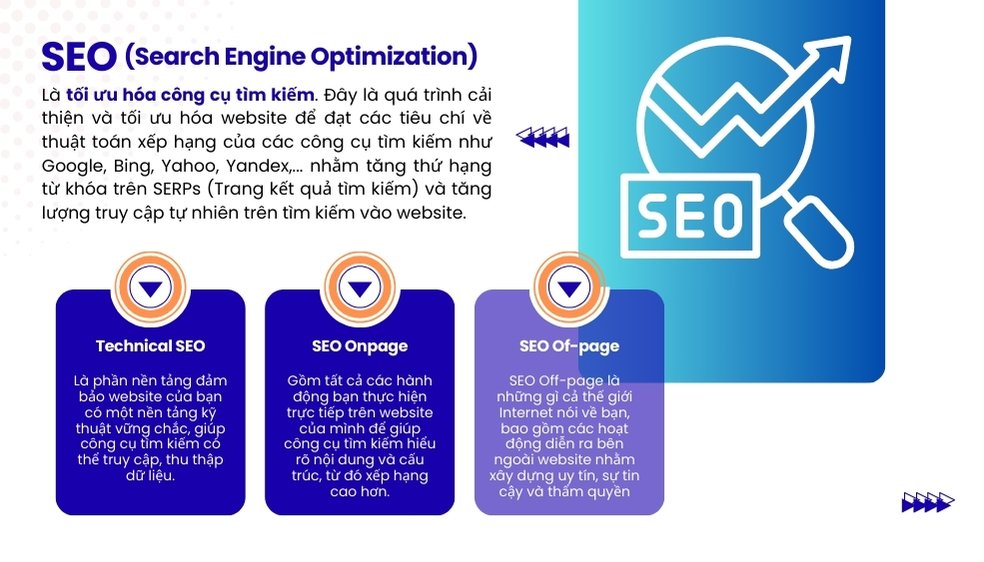
In particular, technical SEO is the solid foundation, Onpage SEO is the entire interior, knowledge and arrangement of the space inside, and finally Offpage SEO is the reputation and prestigious address of that house in the neighborhood.
Whatever the topic of SEO website, SEO strategy, it is necessary to combine all three pillars in harmony.
What is On-page SEO?
On-page SEO includes all the actions you take directly on our website to help search engines understand the content and structure, thereby ranking higher. This is the part you have full control over.
Content is King
This is the heart of On-page SEO. Google always wants to provide the best answers to users. So, create really useful, in-depth, well-researched content and thoroughly solve the problem that users are looking for.
Keyword Research (Keyword Research)
Before writing, you need to “read the mind” of customers. This process helps you find out exactly what words and phrases they are using to search for information, products and services. Building content around these keywords will help you connect with the right target audience. To choose the right goal, understand Types of keywords in SEO and how to group them according to the search intention.
Optimize Title (Title Tag) & Description (Meta Description)
This is your “sign” and “invitation” to appear on the search results page. A catchy headline, a key keyword and a catchy description will determine whether users will click on your page, rather than your competitors’.
Sub Heading Cards (Headings H1, H2, H3)
These tags are like the outline of a book, helping to structure your article logically. Not only does it make it easier for readers to scan and catch key ideas, but it also helps Google to understand what are the main topics (H1) and what are the auxiliary ideas (H2, H3).
Image SEO (Image Optimization)
Images help to animate content, but they also need to be optimized. Filenames with keywords, ATT text, and image compression to prevent page slowdown are important factors that help you rank in both image searches and rankings.
Internal Linking
This is where you place links from one page to other related pages right within your website. This helps navigate users deeper into your content, keeping them staying longer, and also makes it easier for Googlebots to collect data and understand the relationships between content.
What is Off-page SEO?
If On-page SEO is what you say about yourself, then what is Off-page SEO the whole Internet world talks about you, including activities that take place outside the website to build credibility, trust and authority for your brand.
Backlink
This is the most important element of Off-page SEO. Every time another website puts a link pointing to your page, it is viewed as a “vote” of confidence. However, quality is always more important than quantity. A vote from a big, reputable newspaper is worth more than hundreds of votes from junk websites.
Brand Mentions
Sometimes, other websites may mention your brand name without putting a link. Google is smart enough to recognize these mentions and view them as a positive signal of the brand’s level of credibility and popularity.
Social Signals
These are the “talking” about your brand and content on social media platforms like Facebook, YouTube, LinkedIn. While not a direct ranking factor, strong social media virality will help increase identification, attract more traffic, and can bring in more natural backlinks.
SEO Entity
This is the building of a consistent and synchronous brand entity across the Internet. This includes verifying Google Business Profile, creating social networking sites, appearing on reputable contacts pages … to help Google understand “who you are, what you are an expert in”.
What is Technical SEO?
Technical SEO (SEO) is the foundation to ensure your website has a solid technical foundation, which helps search engines can access, collect data and index effectively without any obstacles.
Page Load Speed (Page Speed)
In the digital age, no one has the patience to wait. A slow loading website will cause a bad experience for users and they will get out immediately. Google understands this and prioritizes sites with fast loading speeds.
Mobile-Friendly (Mobile-Friendly)
Currently, the majority of searches are done on mobile phones. Therefore, Google uses the mobile version of the website to rank (Mobile-First Indexing). Your website must be visible and work well on any device.
Site Map (Sitemap)
This is a file that contains a list of all the important pages on your website, serving as a “map” for Googlebot. Sitemap helps Google make sure that they don’t miss any of your important content.
HTTPS Security
The blue padlock icon in the browser address bar is HTTPS. It encrypts data between users and the website, ensuring information security. Google has confirmed this as an official ranking factor.
Structured data (Schema Markup)
This is a special code you add to your website to “explain” your content to search engines.
For example, you could tell Google “this is a recipe,” “this is a product review,” or “this is information about an event.”
This will help your website stand out more on the search results page (e.g., adding star reviews, cooking times, etc.).
PART IV: THE POPULAR SEO TYPES OF THE NOW
Although the mainstay of SEO remains On-page, Off-page and Technical SEO, depending on the goals and business model the SEO approach can specialize in various forms.
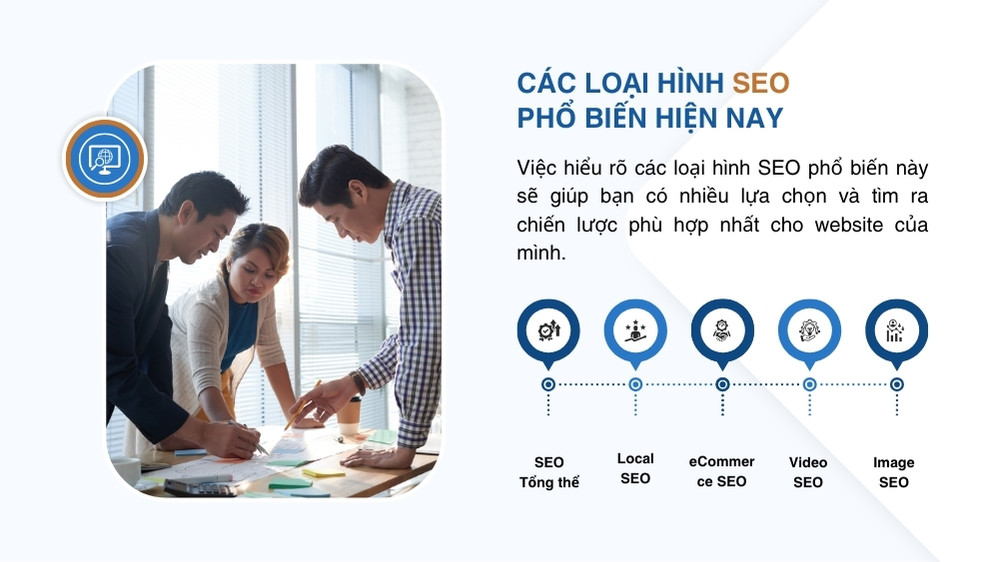
Understanding these common types of SEO will help you make choices and find the best strategy for your website.
SEO Keywords
This is a traditional approach, focusing on getting one or more specific keywords that generate high search volumes to the top of Google.
For example, a company might only focus all of its resources on ranking for the keyword “interior design.”
While this approach can yield quick results for certain keywords, it is often unsustainable, vulnerable to algorithms, and misses out on a large number of leads coming from other related keywords. Even at the word selection stage, a small decision like SEO keywords with diacritics or without diacritics also affects how Google understands your content.
Overall SEO (Holistic SEO)
This is the most comprehensive and recommended strategy in modern SEO. Instead of focusing on only a few keywords, overall SEO aims to build a website into a Reputable Expert in the entire field.
This strategy smoothly combines all 3 pillars (On-page, Off-page, Technical) to improve user experience, build a strong brand, and answer any questions users may have about your topic.
A website that does overall SEO will have good rankings for hundreds, even thousands of related keywords, which helps bring diverse and sustainable access to any changes of the algorithm.
Local SEO (Local SEO)
Local SEO is the process of optimizing your website to appear to users who are looking for a specific geographic area.
This is an indispensable form for businesses that have physical stores or provide services in a certain location.
- For example: When users search for “nearby coffee shops” or “motorbike repair in Dong Hoi”, the results will prioritize displaying businesses near their location, often accompanied by a map.
- Main Work: Optimize Google Business Profile, collect customer reviews, and build a presence on local contacts pages.
eCommerce SEO (SEO for E-Commerce)
This type of SEO is designed specifically for online sales websites. The ultimate goal is not only to attract visitors but also to improve the quality of your website. increase in sales, so sometimes referred to as “sales SEO”.
SEO for e-commerce focuses on optimizing product category pages, product details pages, navigation structures (product filters), and using structured data (schema) to display prices, stock status, and star ratings right on search results.
Video SEO
With the explosion of video platforms, Video SEO is becoming more and more important. It is the process of optimizing your videos so that they rank high not only on YouTube (the world’s second largest search engine) but also right on Google’s search result page.
This includes researching keywords for the video, writing a catchy title and description, creating catchy thumbnails, and adding subtitles or transcripts to the video.
Image SEO (Image SEO)
For industries like fashion, food, tourism, or design, images are an incredibly big source of traffic.
SEO Images is the process of optimizing image files on your website so that they have a high ranking on Google Images.
The main techniques include naming the descriptive file, using ALT tags, compressing the image size so as not to affect the page loading speed, and ensuring high – quality images.
PART V: MODERN SEO ORIENTATIONS
The era of SEO tricks (bag, headline) to overcome Google has passed, today’s algorithms have become extremely smart and sophisticated.
Google is still in the process of optimizing to match the search goals with the users, i.e. finding the most authentic, useful and reliable content.
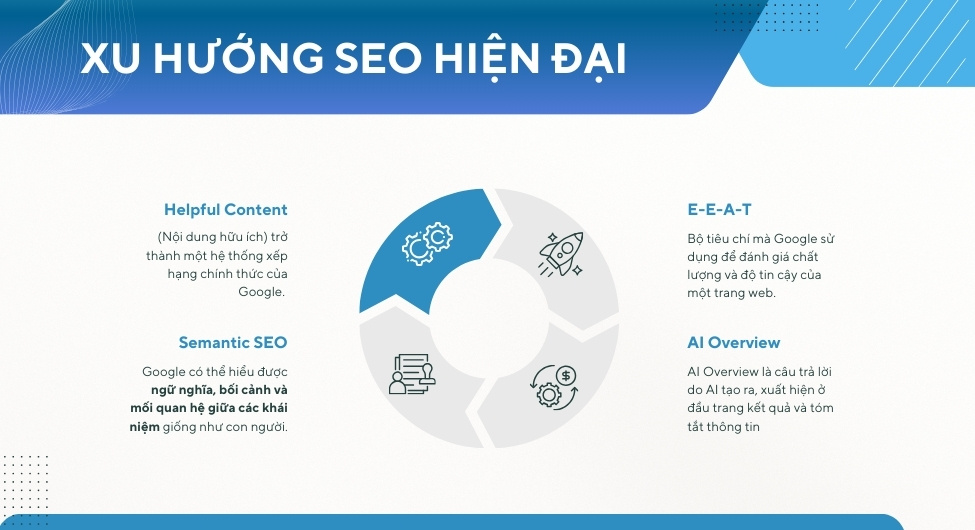
So, modern SEO thinking has shifted completely different from the old, instead of asking “how does Google rank for my website?”, ask “how do my content really help and satisfy users search?”. Here are the core concepts that shape modern SEO thinking in 2025.
What is Helpful Content?
Helpful Content (Useful Content) is no longer a piece of advice but has become an official Google ranking system. This update is designed to recognize and reward content that is created for human beingsAlso, lower the ranking of content that is created primarily to attract search engine clicks.
To create “Helpful Content”, ask yourself the following questions:
- Does this content show real experience or expertise?
- After reading, do users feel they have learned something and achieved their goals?
- Is the content uniquely valuable, or is it just a compilation of what others have written?
Simply put, write what you know best, in a way that is most useful to your audience, and Google will recognize that value.
Xem Google Helpful Content criteria Here.
What is E-E-A-T? Core Factors to Build Trust
E-E-A-T is a set of criteria that Google uses to evaluate the quality and reliability of a website. This is not a direct ranking factor, but it shapes the algorithms for finding high-quality content.
E-E-A-T stands for:
- Experience (Experience): Does the author have direct, real experience on the topic being written about? For example, a product review will be more credible if written by someone who has actually used it for a long time.
- Expertise (Profession): Does the author have in-depth knowledge and skills in that area? For example, an article on financial advice should be written by a financial expert.
- Authoritativeness (Courtship): Is the website or author considered a reputable source of information, authoritative in the industry? This is often shown through backlinks, citations from other reputable sites.
- Trustworthiness (Reliability): Is the website reliable? Is the content accurate, honest? Is the website secure (HTTPS)? This is the most important factor, especially with YMYL (Your Money or Your Life) themes.
What is Semantic SEO ( Semantic SEO )?
Google is no longer just reading individual keywords, but is already understandable semantics, context and relationships between concepts like humans. This is the essence of Semantic SEO.
For example, when you search for “the capital of France”, Google does not just find pages that contain that phrase. It understands that you are talking about the entity “Paris” and also understands that “Eiffel Tower”, “Louvre” are closely related concepts.
Advice: Instead of trying to cram a single keyword into the article, apply the model Topic Cluster (Topic Cluster). Build a pillar page on a big topic (e.g., “Securities investment for beginners”), then create multiple satellite pages (Cluster Pages) that delve into subtopics (e.g., “how to open a securities account”, “what is blue-chip stocks”…). Linking them together will show Google that you’re a true expert on the whole topic.
SEO and AI: AI Overview and Optimization for Google AI Mode
Artificial intelligence (AI) is changing the face of the search result page. AI Overview (formerly known as SGE) is an AI – generated answer that appears at the top of the results page and summarizes information from various sources to directly answer a user’s question.
This means that users can click on any website without any additional effort. So how to optimize?
- Become an AI Cited Source: The only way is to focus on E-E-A-T. Google AI systems are designed to preferentially cite information from the most experienced, professional, and reliable sources.
- Answer the question directly: Structure your content clearly with concise questions and answers. This makes it easy for the AI to “digest” and use your information in its aggregate answers.
- Going deeper than what AI can summarize: Create content that contains personal experiences, insights, case studies, or proprietary data. These are values that AI can’t easily create on its own, and it will encourage users to click on your website to read the full story.
PART VI: POPULAR SEO SUPPORT TOOLS
Whether you are a beginner or an SEO expert, using the right tools will save you time effectively, get accurate data and contribute to help you make effective strategic decisions. Here are the most popular and powerful SEO toolkits that are being trusted by experts around the world. For the production of content, you can refer to the following tools to support SEO standard writing.
Paid SEO Tools All In One
These are paid toolkits that provide a comprehensive solution, including most of the features you need for any SEO campaign.
Ahrefs
Ahrefs is well known for its backlink database which is considered the largest and most accurate in the industry. It is an indispensable tool for analyzing competitors and building an affiliate strategy.
Main Features:
- Site Explorer: “Compare” any website to see their entire backlink profile, which keywords are bringing the most traffic, and which keywords they are running ads for.
- Keywords Explorer: An extremely powerful keyword research tool, which provides important indicators such as search volume, keyword difficulty, and also estimated clicks.
- Site Audit: Automatically “scratch” your entire website to find hundreds of technical SEO errors and give suggestions to fix.
- Rank Tracker: Track your keyword rankings and competitors over time in any geographical location.
SEMrush
SEMrush is a comprehensive digital marketing platform that is strong not only in SEO but also in paid advertising (PPC), content and social networks.
Main Features:
- Competitive Research Toolkit: Provides a detailed overview of your competitor’s online marketing strategy, from SEO to display advertising and social media.
- Keyword Magic Tool: Helps you discover millions of keywords and group them into related topics in a smart way.
- On-Page SEO Checker: Give specific optimization ideas for each page based on analyzing the top 10 competitors.
- Content Marketing Platform: Support from ideation, writing to measuring the effectiveness of the content.
Dedicated SEO Tools
Screaming Frog SEO Spider
If Ahrefs and SEMrush are strategy tools, then Screaming Frog is like a technical “X-ray machine” for your website.
This is a software that you install on your computer that crawls your website in exactly the same way Googlebot does.
- Uses: Help you quickly detect technical SEO errors such as: broken links (error 404), wrong redirect pages, duplicate or missing titles and descriptions, images with too large capacity, structural and indexing problems. This is a must-have tool for anyone who does SEO Audit.
Free tools from Google (Required)
These are the foundational tools, completely free and provide the most accurate data from Google itself. Everyone who does SEO must be proficient with these tools.
Google Search Console
This is a direct “bridge” between you and Google, which is the most important tool to monitor the health of your website in the eyes of Google.
- Provide information: Tell you what keywords users searched for to see you, what your average ranking is, which pages are performing best, which pages are experiencing indexing errors, and whether the website is experiencing security issues.
Google Analytics
If Search Console says how users find you, then Analytics says What do they do after entering your website.
- Provide information: Help you understand who users are (location, age), where they come from (Google, Facebook, …), what pages they have viewed, how long they stayed, and whether they perform important actions (such as making a purchase, filling out a form) or not.
Google Keyword Planner
This is Google’s keyword research tool, designed primarily for Google Ads advertisers but still very useful for SEO.
- Provide information: Helps you discover new keyword ideas and see an estimate of their monthly search volume. While the metrics may not be as detailed as paid tools, this is still a great and reliable starting point.
PART VII: THE OUTSTANDING SEO SCHOOLS
Not all SEO activities are the same. In the SEO industry is now divided into three main schools that are distinguished based on the degree of compliance with Google rules, often portrayed in the color of the hats.
White Hat SEO (White Hat SEO)
This is the orthodox school, which focuses on creating real value for users and strictly adheres to Google’s principles.
White Hat techniques include creating high quality content, improving user experience, and building backlinks naturally.
Though it takes time and effort, this is a strategy most sustainable and safe for long-term website development.
Black Hat SEO (Black Hat SEO)
In contrast to the White Hat, this is a school that uses tricks to manipulate and “surpass” Google’s algorithms to gain rankings quickly.
Black Hat techniques include keyword stuffing, cloaking, mass backlink trading, etc.
Here’s the strategy. Extremely riskyAlthough you can see results in a short time, sooner or later, Google will detect and penalize you severely, maybe even make your website disappear completely from search results.
SEO Gray Hat (Gray Hat SEO)
Lying in between the two camps, Grey Hat SEO includes techniques that are not completely banned by Google but are also not recommended.
Their level of risk is unclear and may vary with algorithm updates. Beginners should stay away from this school until they have enough experience to assess the risk on their own.
PART VIII: IMPORTANT SEO SKILLS
To become a good SEO expert in the present time, you need to equip a diverse set of skills, combining analytical thinking, creativity and technical knowledge.
- Analytical Skills: SEO is a data-based industry. You must be able to read and understand the metrics from Google Analytics, Google Search Console, and other tools to analyze user behavior, measure campaign effectiveness, and make strategic decisions.
- Content Skills: More than just writing, this skill includes developing content strategies, understanding user search intent, and being able to create various content formats (articles, videos, infographics).
- Technical Knowledge: You do n’t have to be a programmer, but you do need to understand the basics of how websites work, HTML, factors that affect page speed, and structured data (schema).
- Marketing and Strategy Thinking: A good SEO understands the big picture of marketing. SEO does not work alone. It needs to work with other channels such as social media, email marketing, and paid advertising to achieve the ultimate business goal.
- Persistence and Adaptability: SEO results take time to come to light and the industry is constantly changing with algorithm updates from Google. So perseverance and a spirit of learning to constantly adapt are two indispensable qualities.
PART IX: SEO ORIENTATIONS IN THE AI AGE
While there are various rumors in the community about what the SEO industry will look like in the future, because of the incredible capabilities of AI.
But for now, artificial intelligence (AI) is not making the SEO profession disappear, but it is changing it in a deeper, better way to serve users. The role of the SEO at this time is shifting from a person who performs manual tasks to a senior strategist with broader thinking. If you’re considering a career, check this out. What is SEOer, work and roadmap before we begin.
At this point, SEO thinking should be:
- AI is Assistant, not Substitute: SEO experts will use AI as a powerful assistant to automate time-consuming tasks such as keyword research, outline creation, writing short descriptions, or large-scale data analysis. The role of the human is to provide strategic direction, quality censorship and in addition to unique creativity.
- The Throne of Expertise and Experience (E-E-A-T): In a world filled with AI-generated content, content that expresses real-world experience, deep expertise and unique human perspective will become more precious than ever. The role of SEO will be to work closely with industry experts to create content that really makes a difference.
- Focusing deeper on SEO Techniques: As AI can do so much with content, it’s even more important to make sure your website has the perfect technical foundation – fast, well-structured, safe and easy for both users and machines to understand.
- Expand beyond Google Search: SEO is no longer just about ranking on Google results page. The new trend is optimization for discovery on a variety of platforms, including voice search (voice search), search by image (visual search), and content optimization for search engines of social platforms such as YouTube and TikTok.
PART X: Frequently Asked Questions (FAQ)
Here are the short answers to complement this beginner SEO handbook, which are also the most commonly asked questions of a lot of you new to learning what SEO is.
What is SEO specifically doing?
SEO is a combination of many different jobs, which can be summarized into 3 main groups:
- Technical Test: Like a “doctor”, SEO will “do a health check” for the website to ensure it runs fast, safe, no broken links and mobile-friendly.
- Content Creation (On-page): Like a “storyteller,” they research keywords to understand customers, then create really useful articles, videos, and images and optimize them for Google to understand.
- Building Reputation (Off-page): Like a “diplomat”, they build relationships to receive quality backlinks and brand mentions from other reputable websites.
Is it difficult to learn SEO and where to start?
SEO is not difficult to understand the basics, but to become a good expert requires perseverance, continuous practice and a spirit of eagerness to learn. The best way to start is:
- Read and understand the background (like the article you are reading).
- Create a personal website or blog on your own to practice. This is the fastest and most effective way to learn.
- Use Google’s free and extremely important tools, the Google Search Console and Google Analytics, to start getting used to the data.
How are SEO and Google Ads different?
Imagine you want to have a store in a prime frontage location.
- Google Ads like you Rental of premises. You pay is to have a nice position immediately for sales. But when you stop paying, you will lose that position right away. This is the solution for quick results, suitable for short-term campaigns.
- SEO like you Build and own a house of yourself. This process takes a lot of time, initial effort. But once completed and in good position, it will be your sustainable asset, bringing customers naturally without spending money on each visit.
Which one to choose? The best strategy combines both: Use Google Ads for immediate results and market testing, while using SEO to build a strong foundation for long – term growth.
How long does it take SEO to see results?
This is a question that does not have an accurate answer, as it depends on many factors such as the level of competition of the industry, the current state of the website and the resources you invest. However, there is a general reference timeframe:
- 3 – 6 months: Start to see the first positive changes like ranking increases for long, less competitive keywords.
- 6 – 12 months: See visible and meaningful results in terms of traffic and lead growth. Remember, SEO is a marathon, not a sprint.
How much does it cost to do SEO?
Costs for SEO are varied:
- DIY: You can start at almost zero cost, just your time and energy.
- Service hire (Agency/Freelancer): Costs can range from a few million to tens, even hundreds of millions per month, depending on the size of the project and the level of competition in the market.
Note: Beware of the “cheap SEO” services that promise to be on the top for several days. They often use Black Hat techniques that can seriously harm your website in the long term.
CONCLUSION
Through this article, hopefully you have a comprehensive and clear view of the SEO world. We have gone together from the most basic concepts, explored how search engines work, learned the 3 core pillars of SEO, and updated the latest trends in the AI era.
Keep in mind, modern SEO is no longer mechanical tricks. It is a continuous, user-centric process, and built on the foundations of Helpful Content (Helpful Content) and the Prestige (E-E-A-T). It is the guideline for all sustainable success.
A journey of tens of thousands of miles always starts with one step. Don’t be overwhelmed by this huge amount of knowledge. Start today with a small action: research the first keywords your customers are looking for.
