
Have you ever wondered why a short sentence from Biti’s or Viettel can be so ingrained in the minds of millions of Vietnamese? If you are wondering, why is it that you can not get the answers you need? What is Slogan And how to create a “lifetime” tagline for your business, you’ve found the right place.
In fact, in more than 10 years of managing SEO and Content, I realize that not only Marketers are still confusing harmfully between Slogan and TaglineThis article will help you distinguish these two concepts correctly, and share the 5-step process to conclude an impressive slogan, helping brands break through the market.
The True Nature of the Slogan: More than Just a Slogan
Many people still think of the slogan as just a catchy phrase to “have fun” or to fill the space on the logo. However, with the perspective of a long-time brand manager, I affirm:
“Slogans are the intangible assets of the business.“
1. What is the Slogan? (In-depth View)
A Slogan is a short, concise statement that typically expresses a promise, core value, or direction for the product or service.
But on the deeper level, The slogan is a condensed version of the “brand promise” (Brand Promise), and if the logo is the face for customers to recognize you, then the Slogan is the voice for customers to understand and believe you. When you say a Slogan, you are publicly committing to the market for the quality or emotion that you will bring.
2. Why is it mandatory for businesses to have a Slogan?
In today’s fiercely competitive environment, a business without a Slogan is like a soldier going to war without a weapon. Here are 3 core reasons:
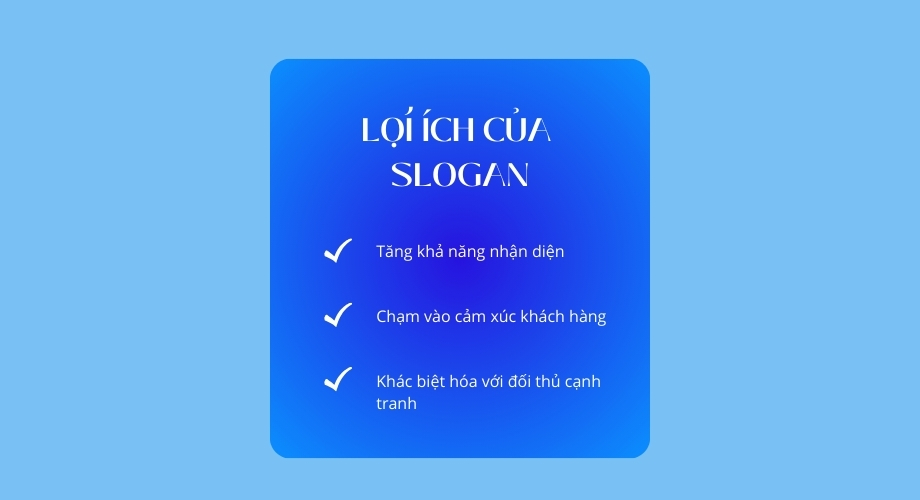
- Increased identification (Brand Awareness): The human brain remembers audio and story information better than mere images. A rhyming Slogan will help brand names “anchor” in customer memory many times longer.
- Touch customer feelings: Customers often make purchases with emotion and rational justification. Good Slogans often hitting “Insight”, which evokes joy, peace of mind, or aspiration, thereby motivating buying behavior.
- Differentiating from competitors: Between a product forest of similar features, the Slogan helps you to separate from the crowd. It answers the question: “Why should I choose my friends over my opponents?”
3. Distinguish Slogan and Tagline (Important Knowledge)
This is where I find 90% of Marketing people, even business owners, get confused. We often call it “Slogan,” but in a well – crafted brand strategy, the Slogan and Tagline play a completely different role. Misunderstanding leads to misapplication of communication strategies.
Here is a detailed comparison table for your ease of visualization:
| Criteria | Tagline (Positioning Structure) | Slogan ( Slogan ) |
| Purposes | Condense the spirit, business philosophy of the whole enterprise. | Often used to promote, describe a product line or a specific advertising campaign. |
| Time of existence | Very long (can go brand lifetime). | Shorter (usually varying by campaign or period). |
| Range of | Attached to Logo and Brand Name. | Attach to a campaign or product. |
| Flexibility and flexibility | Replacement is rare, unless the business is re-branding. | Flexible to adapt to market tastes. |
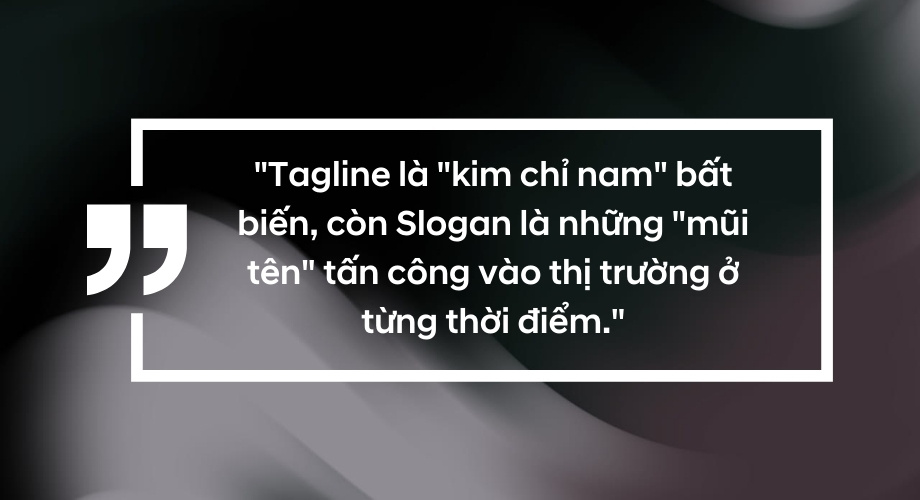
In short: The tagline is the constant guide, while the slogan is the arrows that attack the market from time to time.
See more detail: How to distinguish the difference between tagline and slogan.
4 Core Elements That Make a Good Slogan
How to know a slogan is “hay” hay “bad“?
We cannot judge based on personal feelings like “I see it rhymes”. With experience working in the content and SEO industry for many years, Duan summed up 4 gold standards to measure the quality of a slogan.
According to him, a good slogan must converge all the following factors:
1. Concise and easy to remember (KISS Principles)
KISS stands for Keep It Short and Simple (Keep it short and simple), according to research the human brain today absorbs too much information, they do not have time to read a long sentence.
- Ideal Length: Better be under eight words.
Why, why?
Psychological studies indicate that short-term human memory best processes short phrases, and the shorter the Slogan, the higher the likelihood that customers will recall it when seeing your product.
For example: Kangaroo – The leading water purifier in Vietnam. (It’s a long shot, but it gets right to the point and it’s memorized over and over again.)
2. Unique (Unique)
Never copy someone else’s slogan even a little bit, and do n’t use clichés that everyone can say, like “Best Service,” “Top Quality,” or “Top Reputation.”
- Problems: If you say you are “the number one” but have no evidence (metrics, prizes) then customers will take it as a boast.
- Solution: Find the one thing that is unique to you. Instead of saying “Best coffee,” say “Roasted coffee on the spot,” make it specific, make it reliable.
3. Suitable for target customer group
This is the mistake that many SMEs make, whether it’s selling to Gen Z using 90s language, or selling high – end B2B using overly wordy language.
- With Young Customers (Gen Z): Slogan needs disruption, ego, modern language.
- For business (B2B) or specific industry (Medical, Law): The slogan should be formal, solid, and professional.
4. Emotional appeal or commitment
Slogans are n’t just information. They’re emotions.
- Emotional Suggestions: When reading the slogan, do customers feel happy, secure, or inspired? (Example: Biti’s – Vietnamese Foot Care evokes national pride and kindness).
- Commitment: It’s like a brand oath, for example if the slogan is “Fast delivery in 2 hours”, you are required to do it, otherwise the slogan will become “sticks you beat your back”.
The 5 Steps to Creating a Slogan (Experience) Process
A lot of you ask me: “Hey, how do I come up with an idea? I’ve been staring at the screen all day and I can’t write a sentence.”
Actually, creativity is not waiting for “lady” to knock, but a serious labor process. Here are the 5 steps that my team and I often apply to produce quality slogans for customers:
Step 1: Understand the brand (Brand Audit)
Before you write, answer honestly questions about your business, because you can’t introduce someone without knowing them.
- Who are you? (Brand personality: Fun, serious, classy or casual?)
- What do you sell? (Core product).
- What is USP (Unique Selling Point Benefit)? What sets you apart from the competition? Is it cheap, fast delivery, exclusive technology or service attitude? For example: If you sell pizza and your strengths are “hot,” focus on the temperature and speed, not “fresh ingredients” if that’s not your strongest.
Step 2: Research your competitors
Take a market walk (or simply search Google for the top 10 competitors), the goal being to avoid overlap and find “empty niches”.
How to do:
- If 10 competitors are all talking about “Quality,” say “Speed.”
- If they’re talking about “Cheap,” you’re talking about “Premium.”
- Do n’t try to shout louder than your opponent, but say something different.
Step 3: Brainstorming & Keyword Matrix
Do n’t try to write a complete sentence right away, but start with keywords.
- Listing: Write down on paper all the Verbs and Adjectives related to your industry and USP. As much as possible.
- Pairing: Start putting words together at random. Don’t be afraid of being wrong, don’t be afraid of being silly. At this stage we need the amount of ideas.
Real Estate Industry Example: Settlement, investment, profitability, sustainability, home, tectonics … -> Grafting: tectonics, sustainable investment …
Step 4: Condensing and Grooming (Stage “sharpening”)
From the draft list in step 3, pick the three to five most potential sentences and start editing.
- Shorten: Remove any extra words (e.g., “is”, “of”, “those” etc.).
- Rhyming: Here’s my secret. Slogans have rhymes, and rhymes are 50 percent easier to remember than prose.
For example: Instead of saying, “Barbecue is delicious,” change it to, “Barbecue sizzles, eating is delicious” (rhymesically).
Step 5: Inspection and Survey
This is a very important step, but I’m often overlooked.
- Brand Protection Test: Look up the slogan to see if anyone has registered the copyright. You do not want to spend money on printing packaging and being sued for intellectual property infringement.
- Consult (A/B Testing): Don’t just ask your family members (they usually compliment you). Ask your coworkers, or it’s best to do a demo of a target group of customers.
Questions to ask: “Do you immediately understand what we sell?” and… “How did you feel when you heard this?“.
Analysis of the classic Case Study Slogan
The fastest way to be good is to learn from the best, but we don’t learn how to copy words, we learn the mindset behind the mythical slogan. Here are 5 examples that I often take as an example in human resource training sessions.
1. Apple – “Think Different”
Slogan: Think Different
Background at the time: In 1997, Apple was struggling and was seen as second to “giant” IBM. Steve Jobs was back and needed a message to both uplift the morale within and reposition the brand.
Analysis:
Grammatically, it should have been “Think Differently.” But Apple deliberately used the adjective “Different” to make it a concept, a way of life, not just a way of thinking.
Apple doesn’t sell computers in this slogan. It sells glory to the “rebellious,” the crazy geniuses who dare to change the world. When customers use Apple, they feel they belong to that elite group.
Lessons for you: Don’t just talk about features, but sell customers an “Identity.” Show them who they are when they use your product.
2. L’Oréal – “Because you’re worth it”
Slogan: Because you’re worth it
In-depth analysis:
Before that, cosmetic advertising had often focused on “Being beautiful for men to see.” L’Oréal revolutionized the way women were viewed: Being beautiful for themselves.
The phrase “You deserve” hits on Self-esteem (Self-esteem). It is also a skillful handling of the price.
L’Oréal was priced higher than the general market, and this slogan was the perfect justification: High price for good quality, and you deserve the best.
Lessons for you: Slogans can be tools to handle price rejection right from the customer’s mind, by enhancing their emotional value.
3. Biti’s – “Lifting Vietnamese feet”
Slogan: Vietnamese foot lift
Background: In the early 2000s, the Vietnamese footwear market began to have competition. Biti’s needed to assert its position as a national brand.
In-depth analysis:
- About the wording: The verb “to cherish” is extremely expensive. It evokes meticulous care, care, protection – the right properties of a durable shoe.
- About emotions: The phrase “Vietnamese feet” arouses national pride. It is not just shoes, it is a companion with Vietnamese people going through all walks, from students to workers. This is the perfect combination between reason (durable, smooth) and feeling (proud).
Lessons for you: With Vietnamese brand, hit on national pride or cultural proximity is always a smart and sustainable way to go.
4. Viettel – “Say it your way”
Slogan: Speak your way
In-depth analysis:
Before Viettel, the telecom industry was seen as monopolistic and rigid. Customers had to listen to the carrier.
The slogan is a statement that reverses the situation: Viettel puts customers first. It’s like an invitation to dialogue: “You say it, we’ll listen, no matter who you are, rural or urban.” It shows a high degree of respect for personalization.
Lessons for you: The slogan is shrugged to respect the customer, but make the customer the protagonist of the brand story.
5. Vinamilk – “Vietnam’s High Rise”
Slogan: Vietnam High
In-depth analysis:
This is a classic example of tying corporate mission to national mission.
- Literally: Drink milk to grown-up, healthy children (Product Benefits).
- Glossary meaning: A new generation of Vietnamese develops in intelligence and stature, bringing the country forward (Macro Aspirations).
The slogan helped Vinamilk not only be a milk company, but become a symbol of national nutrition.
Lessons for you: If your product serves the masses, try attaching it to a Social Mission Statement (CSR)This generated a huge amount of sympathy from the community.
In short: Looking at the 5 examples above, you will see something in common: There is no slogan that says “I sell the best product.” They all talk about emotions, people, and values.
- Apple’s Slogan for Selling Innovation
- L’Oréal sells confidence
- Biti’s sells considerate
- Viettel sells respect
- Vinamilk sells hope.
That’s the secret to creating a slogan that will live on.
Slogan or industry-specific suggestions
If the process above is “backbone”, this part is “flesh”. Duan has noticed that every industry has its own “DNA” about language. You cannot bring the humor of F&B to apply to Healthcare.
Here is the analysis Insight (Intuitive Truth) and “expensive” keyword sets for the 7 most popular industry groups, with suggested slogan templates for your reference:
1. Health & Pharmaceutical Industry (Slogan for peace of mind)
Unlike other industries, customers who come to Health often carry anxiety. Therefore, slogans must absolutely not use shocking, sensational or joke words.
💡 Dig deeper into this industry group, you can refer to the set Healthcare slogan creates trust and how to put Message for Hospital To see how the secure “gene” works.
- Insight: Customers need reliability, safety, a sense of shelter and hope for recovery.
- Keyword “expensive”: Dedication, care, health, gold, faith, hope, sharing, peace.
Suggested Slogan Form:
- “Health care, anxiety sharing.”
- “Serve as a family.” (Commitment to service attitude).
- “Strength of belief, endurance of health.” (Emphasizing the causal relationship between mental and physical).
2. Education & Training (Liberal Slogan)
Education is about selling a “dream” about a better version of the future learner, and parents will need to buy peace of mind about the results, students buy inspiration, and knowledge.
💡 With the spirit of liberation, see more anthologies learning slogan for Gen Z and… inspirational study abroad slogan to catch the learner’s “insight.”
- Insight: Toward transformation, bright future and sustainable companionship.
- Keyword “expensive”: Incubation, future, beginning, wisdom, reach, creation, launcher.
Suggested Slogan Form:
- “Invoke knowledge, light up the future.”
- “Practical learning, doing in Practice.” (Suitable for vocational training centers, skills – hitting the pain “learn parrot”).
- “The place of the beginning of leaders.” (Putting on ambition and high-level positioning).
3. Business & Retail Industry (Slogan drives action)
In retail, customers have too many choices. The slogan must act as a “nudge” for them to make an immediate purchase decision or remember your strongest points.
💡 Want stronger “sale close”, compare with stock Good slogan about business or high-end product group such as Real estate slogan helps close the sale quickly.
- Insight: Focus directly on benefits, speed, convenience, or price/quality commitments.
- Keyword “expensive”: Convenient, top, economical, consignment, solution, smart.
Suggested Slogan Form:
- “Shop smart, get gifts.” (Invigorates greed and excitement.)
- “Real quality, real value.” (Build trust in the context of rampant counterfeit goods).
- “Give solutions, get trust.” (Suitable for B2B model – Business sells to business).
4. F&B & Food Industry (Slogan awakens the senses)
F&B Golden Rule: Read to feel hungry, hear to feel craving. Slogan is not dry, but “reflective, evocative”.
- Insight: Emphasis is placed on taste (taste), space (warmth) or origin (freshness). The element of “home rice” (nostalgia) is also very strong.
- Keyword “expensive”: Smooth, fresh, flavorful, kitchen, complete, quintessential, excellent.
Suggested Slogan Form:
- “Delicious to the last drop.” (Emphasizing full satisfaction).
- “It tastes good on my own cooking.” (Put on homesickness and hygiene and safety.)
- “Tinh hoa ẩm thực [Tên địa phương].” (Example: Tinh hoa ẩm thực Huế – Định vị đặc sản vùng miền).
5. Environmental & Clean Agriculture Industry (Green Logan)
This is the trend of the times. Slogan this industry should be gentle, clear and show social responsibility.
💡 If branding is tied to social responsibility, refer to how to write meaningful environmental protection slogan to convey the “green” spirit.
- Insight: Towards sustainability, back to nature, long-term health protection.
- Keyword “expensive”: Green, clean, natural, root, sustainable, pure, germ-free.
Suggested Slogan Form:
- “Live green for a better tomorrow.”
- “Pure from Nature.” (Chemical – free commitment).
- “Clean farming, green vitality.” (Linking products to consumer health).
6. Tourism & Hospitality Industry (Slogan Experience)
Travel is about selling “moments” and “memories”, so Slogan needed to open up a space of imagination, stimulating “crazy legs”.
💡 See more anthologies brand positioning travel slogan To see how “foot – crazy” is wrapped up in a few words.
- Insight: Sell relaxation, discover new things, get out of the pressure of everyday life.
- Keyword “expensive”: Explore, journey, enjoy, paradise, destination, mark, wonder.
Suggested Slogan Form:
- “Experience the moment.” (Focus on mindfulness and enjoyment.)
- “More than a trip.” (Promises emotional value beyond expectation.)
- “Awaken the shifting dream.”
7. Technology & IT industry (Slogan Breakthrough)
Technology is often seen as dry, complex, and a slogan or slogan makes technology simple and accessible to humans.
- Insight: Emphasis is placed on innovation, speed, connectivity and problem solving.
- Keyword “expensive”: Connected, pioneering, groundbreaking, smart, epoch-making, optimized, speedy.
Suggested Slogan Form:
- “Connecting value, creating the future.” (Macro-level mission).
- “Technology for the Humane.” (Assertion that technology serves people, not replaces people).
- “Simplify all challenges.” (Promise of convenience and smart solutions).
Slogan Creation Tools (And Tips from Duan)
There are days when ideas come to mind, but there are days when you sit at your computer all day and your mind goes blank.
That’s when you need the help of technology, but remember that the tool is only an assistant, not a decision maker.
Popular slogan creation tools
If you’re “stumped” on a keyword or don’t know where to start, then try taking a walk through these free tools for inspiration:
- Shopify Slogan Maker: This is the very famous tool of Shopify ecommerce platform. You just need to enter a keyword (e.g., “Coffee”), it will return hundreds of suggestions containing that keyword.
- Zyro AI Slogan Generator: This tool uses artificial intelligence to match words. It has the ability to produce sentences that sound strange and creative.
- Oberlo Slogan Generator: Similar to Shopify, this tool is suitable if you are looking for commercial, sales slogans.
- ChatGPT/Gemini: Don’t forget these modern AI assistants. You can prompt in more detail, for example: “Play the brand expert, suggest me 10 funny, short-lived slogans under 6 words for a student milk tea shop.”
Important Notes
As a professional for more than 10 years, I recommend you never to bring raw materials of the machinery as the official slogan.
Why, huh?
Because machines are only probabilistic word – assemblers, they lack the most important thing: Human Insight.
- Machines do n’t know if your customers are sad or happy.
- Machines do n’t understand the local culture or the slang that young people are using.
- Machine – made slogans are often “industrial” and lifeless.
Advice: Use the tools to get keyword ideas Brainstorming, then using your mind and heart to reframe the statement into an emotional statement.
Mistakes to Avoid When Placing Slogans
A good slogan can elevate a brand, but a bad one can make a brand laugh or even get into legal trouble.
Here are 4 “traps” that a lot of businesses fall into:
1. Use clichés, exhortations
This is the most common error. A lot of companies prefer to use words like: “Top”, “No.1”, “Zenith”, “Perfect”, “Best”.
- Customers today are smart and suspicious. If you exclaim “No. 1” that your product is normal, they will assume that you are “exploding”.
- How to fix: Instead of using cliché adjectives, use specific verbs or nouns. For example: Instead of saying “Best shipping service”, say “Delivery in 2 hours”.
2. Slogan is too long, read it and forget the first paragraph
The slogan is not a speech.
- A slogan that is 10 words long will overwhelm your customers’ brains. They will skim through your ads for 1-2 seconds, they do not have time to read and think.
- How to fix: Use the “one breath” rule. If you can’t read the slogan in one soft breath, it’s too long. Cut out the extra words “is,” “the,” “the,” “of.”
3. Misleading culture or language
This error is common when you translate slogans from Vietnamese into English (or vice versa) without understanding the native style. Or use slang, local words that other regions hear objectionable.
- For example: KFC fried chicken company once had slogan “Finger Lickin’ Good” (Tasty on every finger). When it came to China, due to the wrong translation, it turned into “Eat your fingers.” – sounds very creepy.
- K-wayFix: Double check the meanings of the words in different regions before you close.
4. Forgot to register intellectual property rights
You come up with a great sentence, print it on signs, on packages, run an expensive ad. All at once, your opponent sues you because they’ve already registered it.
- Consequences: You lose your brand, you have to make amends and start over.
- K-wayFix: As soon as you have a slogan, go to the NOIP website to see if anyone has used it and apply for protection immediately.
Conclusion
The journey of finding answers to “What is Logan?” Ours has come to an end. Hopefully through this article, you have understood that the slogan is not just a saying for oral fun, but an intellectual property, a steely commitment of the business to customers.
Having a good slogan, it is impressive that you have won 50% in the battle for customers’ minds. However, please remember this: “Slogans are promises, and the actions of the business are what keep them.“.
- Do n’t talk… “Dedicated” if your employees are still grumpy with guests.
- Do n’t talk… “Quality” if the product is defective.
Let the slogan be the guideline for all actions of your business.