

What is content pillar that can completely solve the pain of making content emotionally, discretely and not knowing what to write today? Is this the reason why you have written a lot of SEO traffic that still does not increase the sustainable field.
That’s right! Without a strategic framework when writing content, of course, all your efforts can become fragmented.
Content pillar or pillar content is the fundamental solution to solve this problem.
In this article, I will use my experience in implementing SEO content services for hundreds of websites so far, to help you understand the most basic way about what is the content pillar and what is the topic cluster and how to build it.
This way you can easily understand how to systematize the entire website content, never run out of ideas and create a solid SEO platform for the future.
💡 Topic cluster is a strategy, but each article in the cluster should still be good content — starting from understand the content and how to make it.
What is Content Pillar?
Content pillar are the key themes that play a core role in a strategy. content marketing. Enterprises will rely on content pillar to focus resources to develop content around these topics throughout.
These pillar content act as the main pillars that support the entire content structure, with the goal of creating a consistent, coherent and high-value content system. Helps define content orientation and directly support marketing goals such as building brand identity or attracting potential customers.
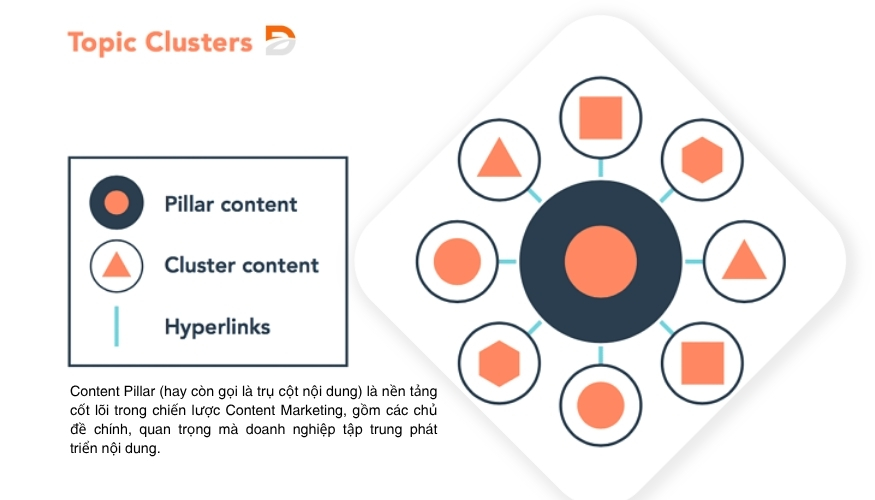
In simpler terms, a content pillar is an overview of a large, in – depth topic, a core issue that your target customer is interested in.
To make it easier to visualize, use the analogy of “the tree”:
- Your website is a garden. Instead of planting 100 individual, discrete seedlings, your goal is to plant 5 “Pillars” that are strong.
- Content Pillar is the “stem”. This is the core platform, covering the entire topic.
- The detailed articles (satellite articles) are “branches, leaves”. They grow out of “trunks” to explain in detail each small aspect of the topic.
As you implement this model, you will often encounter new related terms and understanding them is important to formulate the strategy correctly.
In fact, a lot of you confuse the two concepts of content pillar and content angel. This confusion often comes from overlap in content building but lack of understanding of the scope, goals, and strategic tier of each concept.
Distinguish content pillar and content angle
Imagine you’re building content for a “cooking” channel, where the content pillar is the trunk, and the content angel is the branches and leaves.
1. Content Pillar (Pillar/Stem)
- Is “what”: What big topics do you decide to talk about?
- Purpose: To shape your channel. The viewer who looks at it knows right away: “Well, this channel is specialized in…”
- Properties: Very broad stable, and long lasting. You will come back and forth to these topics all year.
- For example: Pillar 1: “Asian dishes”; pillar 2: “Barbecue & BBQ”
At this point, you will not be changing these pillars weekly because they are the foundation of your channel.
2. Content Angle (Viewing Angle/Leaf Branch)
- Is “how”: How would you exploit the big topic above for engaging?
- Purpose: To make your content diverse, fresh, and engaging, the goal is to avoid making every post look the same.
- Properties: Very narrow, flexible, and short-term (usually only for 1-2 posts/video).
Example: I take the pillar 1 “Asian dishes”, we have a multitude of angles to exploit:
- Angle (Guide): “Guide to make beef noodle soup with Hanoi taste in 30 minutes”
- Angle (Story): “The first time I failed to cook Thai curry…”
- Angle (Compare): “The difference between 3 types of Korean kimchi”
- Angle (Saving): “Cooking Asian 3 course dinner with only 100k”
- Angle (Theo trend): “Try making hot 7 level spicy noodles on TikTok”
Anti-mistakable summary table
| Elements | Content Pillar (Pillar) | Content Angle (Viewing Angle) |
| Key Questions | You talk about… – What’s the…? (Large topic) | You talk about it. How to do it? (Approach) |
| Range of | WIDE (E.g. Skin Care) | NICK (E.g. 5 mistakes when using sunscreen) |
| Like… | Stem, Foundation | Branches, leaves, decorative tiles |
| Stability | Stable (Used all year) | Flexible (Continuous Change) |
| Number of items | Less (3-7 Pillars) | Multiple (Innumerable Viewing Angles) |
Differentiation table from another perspective
| When you have an idea… | Try asking… | If the answer is… | …then that’s… |
| Idea one: “Parenting” | Is this a column or a headline? | CYBER | Pillar |
| Idea two: “How can I eat vegetables?” | Is this a column or a headline? | Title (Question) | Angle |
| Idea three: “Digital Marketing” | Can you write one or 50? | 50 Posts | Pillar |
| Idea four: “5 steps to running Facebook ads” | Can you write one or 50? | 1 lesson (instruction) | Angle |
| Idea 5: “Lose weight” | Is it a Noun or a Title? | Nouns (Subjects) | Pillar |
| Idea 6: “I lost five kilos in a month.” | Is it a Noun or a Title? | Title (Story) | Angle |
Distinguishing key terms in the Topic Cluster model
When researching or applying pillar content, you will encounter some terms related to pillar in marketing, here is one of them:
Core Topic:
This is your initial idea, the big deal, that you want your website to be an expert on (e.g., “Digital Marketing,” “Securities Investment”).
Pillar Page / Pillar Content:
This is the tree trunk article we’re talking about. These two terms are essentially the same.
- Pillar Page is the term for the web page containing that content (e.g. articles
domain.com/digital-marketing-la-gi) - Pillar Content This article covers the entire core topic and contains a lot of hyperlinks pointing to sub-posts.
Cluster Content / Subtopic Page:
- These are the “leafy” articles, or Subtopic Page.
- They go into depth explaining in detail an aspect of Core Topic (e.g., “What is SEO,” “What is Content Marketing,” “Running Facebook Ads”).
- Each of these articles will link back to the Pillar Page.
Topic Cluster:
This is the name for the entire linking model including 1 Pillar Page and many Content Clusters around it. Some places may use terms such as Pillar Cluster hay Content ClusterBut they all share this same model of strategy.
Evergreen Content:
This is a characteristic rather than an ingredient, only content that has sustainable value, that is not outdated over time (e.g. “How to Cook Beef Noodles” is evergreen, but “Stock Market News Today” is not). The Content Pillar is almost always Evergreen Content.
Why is it mandatory for businesses to have content pillar?
With my experience in consulting marketing solutions for small businesses, I have realized that every business must have content pillar. This is not a choice should have or not, but it is the core foundation to help organize content strategy effectively, instead of producing emotional and discrete content.
The investment in building content pillar brings 4 practical benefits and long-term value:
- Helps permanently solve the worries of running out of ideas: Because when you identify a solid trunk, you automatically know what content you need to develop, which posts to write next. This helps to plan a clear content roadmap for the next 6 to 1 years, which is beneficial when using resources effectively and especially easy to expand on in the future.
- Building credibility and authority: Content pillar helps you focus on becoming an expert on core topics in the industry. With in-depth and quality content production around these topics, you are building a strong professional reputation. Google will then recognize this and increase your credibility and rank your entire theme cluster higher.
- Promote overall SEO and increase quality access: Content pillar is the center of the topic cluster model. This is a closely linked content system that helps search engines such as Google understand the structure and expertise of your website. On the other hand, the close association between content pillar (pillar page) and content cluster will form a solid content block, contributing to improving SEO rankings, attracting quality traffic thereby increasing higher conversions.
- Consistent message and experience: Focusing on core themes helps you deliver your message consistently, position your brand clearly, and increase awareness in your customers’ minds.
Overall, content pillar is a solution that gives users a complete industry knowledge map. When reading the pillar article, they can easily click on internal links to learn more in-depth about the aspects they are interested in. This keeps them on the page longer and delivers a valuable content experience.
Real-world view from Duan Digi:
“Many content teams make the mistake of focusing on long-tail keywords, in a discrete way. They may have traffic, but they don’t build authority.
For me, when you build pillar is you are telling Google that: I am an expert on this topic. That is how to do SEO most sustainable.”
Identification characteristics of a standard Content Pillar
In fact, not all long articles are content pillar, because a standard content pillar must converge all 5 core characteristics:
- Comprehensiveness (Comprehensive): It should cover the entire A-Z topic, like a handbook or an overview table of contents, where the reader can find all aspects of the problem.
- Evergreen: Pillar content is focused on foundational knowledge, which is of long-term value and not outdated quickly in line with trends (like daily news).
- Navigation (Navigational): This is an important feature. Post Pillar contains a lot of internal links pointing to the satellite post (Cluster) for the reader to learn more in depth, it serves as a traffic hub.
- Target Key Words (High-Volume): It typically targets short, high – volume keywords and an overview intent (e.g., “Digital Marketing”, “Stock Investment”).
- Clear Structure: The article must have an extremely logical, coherent heading (H2, H3) structure so that users can easily scan their eyes and find the information they need.
How does the Topic Cluster model work?
A Content Pillar cannot work effectively if it stands alone, but it needs to be deployed in a strategic model called topic cluster.
This is the most effective way to organize and link your content together, with three core components:
1. Pillar Page
This is the central article, which is the “tree trunk” of the entire topic cluster.
- Targets: Target short, high – traffic, generalized keywords, such as “What is Content Pillar?”
- Contents: Articles are usually very long, often over 3000 words, covering all aspects of the big topic. But do not go too deep into the details of each aspect, which serves as an overview table of contents.
2. Cluster Content (Satellite Content)
These are detailed articles, which are “twigs” that grow from the trunk of the plant.
- Objectives: Target long – tail keywords or specific questions, such as “how to build content pillar” or “examples of pillar content”.
- Contents: Each of these articles will go into depth explaining in detail and detail a specific aspect that has been covered in the Pillar Page.
3. Internal Links System
This is the key element, which is the glue that holds the whole model together. Without this system, you only have discrete articles, not a scientific and logical topic cluster.
The linking rule you are required to adhere to is:
- All cluster content articles must link to the pillar page.
- The pillar page must also link down to the corresponding cluster content articles.
This two – way link creates a tight content network that helps both users and Google understand what’s most important and that your website has deep expertise on the topic.
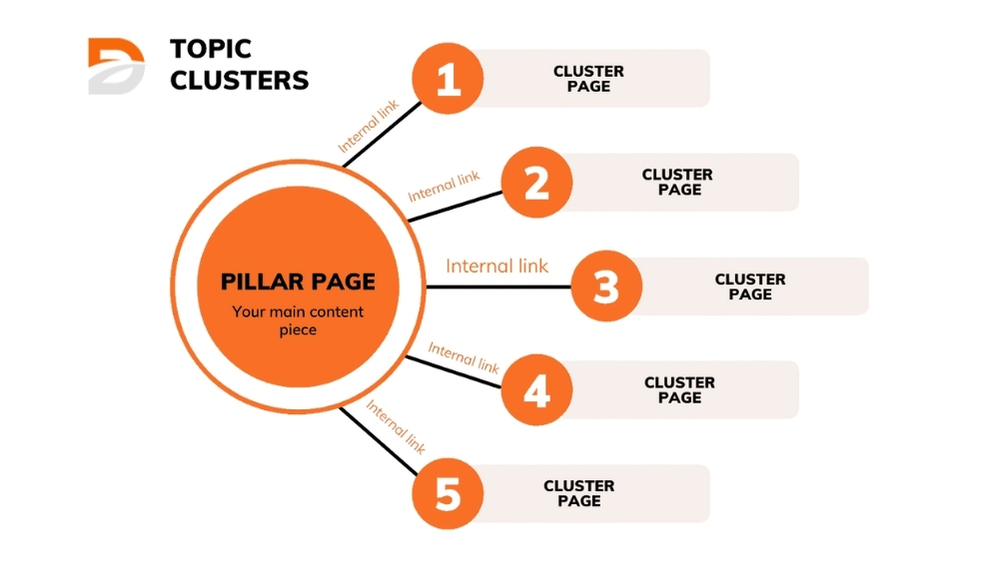
Hình ảnh minh họa mô hình Topic ClusterCriteria of a quality pillar page (Actual checklist)
In order for Google and users to recognize your article as a quality Pillar Page, it should meet the following criteria. You can use this as a checklist:
About Content (Helpful Content):
- Thoroughly solve: The article answers all the main questions related to the topic. After reading, users do not need to return to Google to search anymore.
- Offering unique value: The content must express experience, practical experience (E-E-A-T) that nowhere else has.
- Is the content “often green”: The information must be accurate and of lasting value.
- Not superficial: Even if it’s a general overview, each section should provide value, not empty bullet points.
About Optimization (SEO & Experience):
- Key Keyword Optimization: Key words (high volume) appear naturally in the title, H1, and throughout the article.
- Clear Structure: Logical H2, H3, H4 hierarchy. There is a Table of Contents at the beginning of the article for easy navigation.
- Good Reading Experience (UX): Fonts that are easy to read, short sentences, have illustrations, infographics, or videos.
- Perfect Internal Links: Closely linked to Cluster cards (satellites) and other related Pillar cards logically.

5 Steps to build content pillar (war food)
Here are 5 real-world steps for you to build your first Content Pillar in a professional way.
Step 1: Select Core Topic
The first step is to find the “trunk.” This is not a single keyword, but a big, overarching problem that your customers are looking to solve.
- How to do: Ask yourself, “What is my client’s biggest interest?”
For example: If you sell CRM software, the core theme might be “Customer Relationship Management” or “Customer Care.”
Tip from Digi Travel: The theme should be wide enough that you can “lay” out at least 10-20 sub-themes (satellite posts), but not too general. For example, “Marketing” is too wide, but “Email Marketing” or “Content Marketing” are good pillar themes.
Step 2: Map keywords for the topic cluster
After you have the “stem”, you need to find the “twigs”. This is the time to use tools such as Ahrefs, SEMrush, or Google Keyword Planner.
Keywords for Pillar (Trunk):
- Search for key, short, high-traffic keywords. These are keywords that express the intention to learn more.
For example: “What is pillar content”, “pillar content”.
Keywords for Cluster (Leafy Branch):
- Find long-tail keywords or specific questions. This is what users ask when they want to know the details.
For example: “content pillar benefits”, “examples of pillar content”, “how to make pillar page”.
Step 3: Outline the pillar article (Pillar Page)
Your column should be the most detailed and comprehensive article you can write on the topic. Its outline should be the “backbone” of the whole cluster.
How to do:
- Take all the “Cluster” keywords you found in Step 2 and turn them into subheadings (H2, H3) in the Pillar article.
For example:
With the Pillar Page as “What is Content Pillar”, your outline will include items such as: “1. Benefits of Content Pillar”, “2. How to Build Content Pillar”, “3. Examples of Content Pillar”, “4. How to…
Important: Each of these subheadings is a “hint” for you to write a detailed Cluster article later.
Step 4: Deploy writing content
This is the time to create content. The actual process should be:
Previous Pillar Page Post:
- Write the “main house” firmly. Make sure it covers all aspects (based on the outline in Step 3) but doesn’t go into too much detail.
Writing Cluster Content Articles:
- Now, take each subheading in the Pillar article (e.g., “Content Pillar Benefits”) and write a separate, detailed, in – depth article that addresses just that one problem.
Step 5: Link them together (Internal Link)
This will activate the topic cluster’s power, and if you skip this step, everything you did above is for nothing.
The link rule is simple:
- From “leaf” to “body”: As soon as you have written a Cluster post (e.g., the post “Example of Content Pillar”), you must immediately insert a link from that post pointing to the main Pillar post (the post “What is Content Pillar”).
- From “body” to “leaf”: Also, go back to the main Pillar, find the exact passage that is talking about the “example” (the outline in Step 3), and insert a link that points down to the detailed Cluster you just wrote.
This creates a 2-way flow of power, helping Google understand the structure of your content.
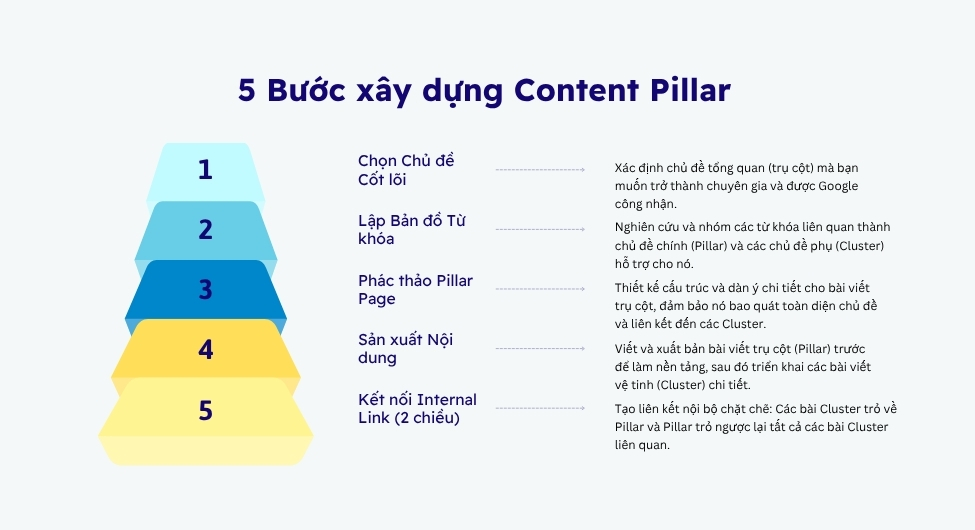
5 Content Pillar Template examples actual template
Since the theoretical part can be a bit hard to visualize but when you look at the actual example, you’ll understand it right away. Here are practical reference templates of how you can build Pillar theme clusters for 5 popular professions.
Example 1: Marketing (Like this website)
Imagine you have a marketing website.
Post Pillar (Trunk): An overview article is called “Instructions for Setting Up Content Plan A-Z”.
Cluster Cards (Leafy Branches): Detailed articles that arise from that article, include:
- “What is a Content Pillar?” (That’s the article you’re reading.)
- “What is Content Calendar?”
- “What’s Contint Strategy?”
Example 2: Finance
Imagine you have a blog that teaches about investing.
Post Pillar (Trunk): A “super-big” article called “Stock Investing for Beginners.”
Cluster Cards (Leafy Branches): Articles explaining small steps for newbies, for example:
- “Where to open a securities account?”
- “What is technical analysis?”
- “Best ETFs 2025”.
Example 3: Health Industry
Imagine you had a website about health and weight loss.
Post Pillar (Trunk): A compilation article called “All the Scientific Weight Loss Methods”.
Cluster Cards (Leafy Branches): The articles delve into each method or tool, for example:
- “The Keto Seven – Day Menu for Beginners.”
- “5 Effective Fat Burning Cardio Exercises at Home.”
- “Guide to TDEE calorie counting.”
Example 4: Real Estate (Investment)
Pillar (Trunk): Apartment for rent A-Z investment guide for newbies.
Clusters (Leafy Branches):
- How to calculate cash flow and profitability of rental apartments.
- Top 5 legal risks when buying apartments
- Experience in selecting areas/projects with high profitability.
- Procedures for bank loans to buy houses for rent.
- Rental contract: 10 terms to note.
- Tips for interior decoration of apartments for rent with guests
Example 5: SaaS (CRM Software)
Pillar (Trunk): What is CRM? A complete set of Customer Relationship Management.
Clusters (Leafy Branches):
- Benefits of CRM for B2B Business.
- How to choose the right CRM software for small business.
- Top 10 Best CRM Software [Year].
- Compare CRM On-premise and CRM Cloud.
- CRM implementation process 5 steps to success.
- Case study: [Customer Name] increased 30% revenue by CRM.
Example 6: E-commerce (Men’s Fashion)
Pillar (Trunk): Guidance for Men’s Coordination at the Office of Exhibition & Professionalism.
Clusters (Leafy Branches):
- 5 basic styles of men’s shirts that must be in the wardrobe.
- How to choose men’s trousers by body type.
- Rules for color matching men’s clothes (Color wheel).
- Guide to choosing western shoes (Oxford, Derby, Loafer).
- Accessories (watch, tie, belt) elevate the suit.
Example 7: Education (Study Abroad)
Pillar (Trunk): Overview of Studying in the US [Year]: Conditions, Costs & Scholarships.
Clusters (Leafy Branches):
- What are the requirements for studying in the US? (GPA, IELTS/TOEFL, SAT).
- How much does it cost to study in the US in total?
- How to write a Personal Statement for a scholarship.
- Guide to the procedure for applying for an F1 visa “certainly win” interview.
- Life of international students in the US: 5 things to know.
- Top 10 “hot” majors that are easy to get a job in the US.
Example 8: Health (Dental)
Pillar (Trunk): Invisalign from A-Z.
Clusters (Leafy Branches):
- How much do transparent braces cost?
- Pros and cons of Invisalign braces.
- Compare clear braces and braces.
- Invisalign braces procedure is detailed in 4 steps.
- How it feels to wear Invisalign braces: Does it hurt?
- How to care for and clean a litter box at home.
What KPIs measure Content Pillar effectiveness?
A very practical question. “How to know if content pillar is effective?”
Here are the most important KPIs you need to keep track of. Note that you don’t just measure the effectiveness of a Pillar, you measure the effectiveness of the whole topic cluster.
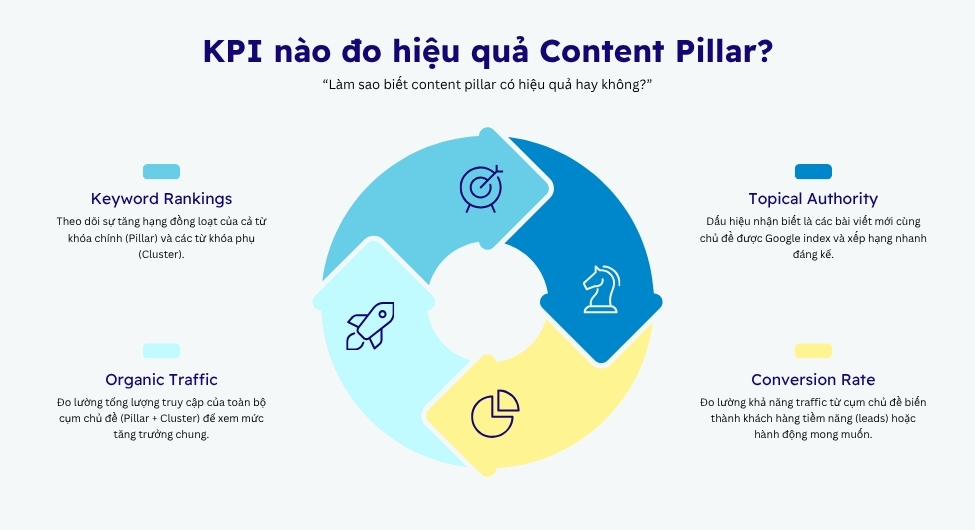
Keyword Rankings:
- Can the main keyword of Pillar be in the Top 10, Top 5?
- More importantly, did the entire set of satellite keywords (of Cluster cards) simultaneously increase rank and reach the Top 10?
Organic Traffic:
- Does the total traffic of the whole theme cluster (including Pillar and all Cluster posts) grow sustainably over time?
Theme Authority (Topical Authority):
- This is a “hidden” KPI. The sign is when you publish a new article It’s the same subject.Google will index and rank that article a lot faster than it used to.
Conversion Rate Index:
- Finally, what does that traffic mean? What is the percentage of people who read this topic subscribe to newsletters, download documents, or schedule consultations?
Common Mistakes When Implementing Content Pillar
Pillar content implementation is very effective but also full of pitfalls. From real experience SEO content services for business partners, Duan noticed these are the most common mistakes that content teams often make, maybe it will help you:
Choose a pillar theme that is too narrow (or too wide):
- Too narrow: Choose topic “How to use A button in X software”. You will not be able to write 10 more Cluster articles.
- Too broad: Choose the topic “Marketing”. You will never have enough resources to write the whole overview and compete with the “big guys”.
The Pillar is just an “empty hexadecimal”:
- This is a deadly mistake that many of you encounter. Many people just write Pillar article by listing the H2, H3 and pointing the link without providing any value.
- The Pillar had to be an in – depth overview, it had to be useful in itself.
Building “home” finished but forgot to make “road” (No internal link):
- You write a pillar and 20 clusters that are very good, but forget to link them together (both the outgoing link and the incoming link).
- It’s like you build lots of beautiful houses but do n’t make paths.
- Google will not understand what they have to do with each other, and SEO power is wasted.
Write finished and “abandoned” (Not updated):
- The world is always changing. Your Pillar “Top 10 CRM 2024” will be obsolete by 2025.
- You have to go back and “refresh” your content regularly, updating your metrics so that your paper is accurate.
- This maintains trust with Google.
Impatience:
You can’t expect a huge pillar ppage to Top 1 in just 1 week. Building the theme competence is a marathon, not a sprint. It requires a persistent investment of at least 3-6 months.
💡 A strong pillar needs SEO standard sub-posts; see how SEO standard sub-posts and… select the appropriate content type for each cluster.
Conclusion: Content Pillar is the foundation, not the destination
In short, content pillar is a method that helps you stop making emotional content and start building content systematically. It is the best way to build authority (E-E-A-T) and a sustainable path to SEO dominance for the entire topic.
Building a complete topic cluster will certainly take time and effort. It is not a job in an instant. But this is the most worthy investment for the long-term development of the website.
If you need an outsourced content writing solution that ensures good writing, does not depend on AI and meets Helpful Content or Google’s latest algorithms for content quality. Check out SEO standard website content writing service his or contact him via Zalo here..
💡 Building a topic cluster is laborious; SEO standard writing recognition clustered to you top sustainable.