

Maybe you write very well, very enthusiastic but posts for months can not be seen on Google? That’s when you need to learn how to write SEO standards. In fact, good writing and SEO standards are not two different stories, but it will be very beneficial to complement each other when publishing content on the internet, as well as writing articles for websites.
The way to write SEO standard content is really not crammed with keywords mechanically as many people mistakenly believe. It is a useful content writing technique for users with scientific content structure, making it easy for Google to understand what your article is talking about.
With his practical experience, this article Duan will share about how to write SEO standards, suggest useful content elements and checklist 30 detailed steps, helping newbies to refer to a comprehensive, easy to understand as possible.
You will find out some of the following core information:
- Thinking to build content that meets Helpful Content
- SEO Optimization Techniques for Articles
- SEO standard writing process from A – Z for newbies
💡 This checklist will be more “easy” if you have clearly distinguished content SEO different from content writing — it is original thinking before optimization.
What is SEO standard writing?
SEO is the process of producing and optimizing website content to be friendly to both search engines and users (searchers). This process involves providing quality, useful information, while optimizing technical elements such as keywords, meta titles, post structure, images/videos, and internal links.
The goal of SEO standard writing is to make it easier for Google to understand and rank content, from measuring search result page visibility (SERP), to attract natural traffic and reach more potential customers.
It can be said that SEO standard writing is the process of perfectly balancing two factors: the quality of content for users and technical optimization for search engines.
It consists of two main pillars:
- User satisfaction (Helpful Content & E-E-A-T) This is the soul part of the article, so you must answer the exact, complete and insightful question or problem the user is looking for (also called Search Intent). Your content must clearly show your expertise, practical experience and provide unique value, which readers can not find elsewhere (other website).
- Google Friendly (Technical SEO On-page) This is the physical part of your post, so it needs to be presented and structured in a scientific way so that Google’s robots can easily “read”, “understand” and “rank” your post for the right topic.
In short, SEO standard writing The art of turning valuable content into content that is easily found and appreciated by search users or search engines.
Misconceptions about SEO Standard Writing (Need to Change Now!)
During the strategy consultation process, I noticed that many content teams are still clinging to outdated concepts, so despite their efforts, their content still does not yield results.
You have to know that SEO content writing in 2025 is a lot different than it was in 2024, let alone in previous years.

Mistake 1: SEO standards are to cram keywords at some rate
There are many of you still have the idea that repeating the main keyword in the article with a density of 3 – 5 % will be on the top. But no, “keyword stuffing” or technical techniques “Keyword Stuffing” has been severely penalized by Google for a long time.
Modern algorithms (such as BERT) help Google understand semantics and context. Instead of stuffing a keyword, Google wants you to write about the topic naturally, using a variety of synonyms, related words (LSI) and professional terms. Writing naturally for readers is also the best way to optimize SEO.
Mistake 2: Posts must be long over 2000 words new standard SEO
The old concept previously commonly used was to write as long as possible, Google by default prefers long articles because the much content should be valuable.
This is a completely wrong idea.
With Helpful Content in 2025, the length of the article is not equal to the content depth and relevance.
Google ranks content based on ability satisfy the search intention (Search Intent)I.e. with an article 800 words answer straight, correct and definitive product price question X will be appreciated more than a post 3000 words rambling. Please write deep enough so that users do not need to return to Google search anymore, that is the goal, not run by the number of words.
Mistake 3: SEO standard writing is a dry, machine-readable writing style
I realize that there are still some people who do n’t like writing content with a personal touch or tone, and that’s completely wrong.
This is the most dangerous mistake in the E-E-A-T and AI eras. When AI can create a series of “SEO-standard” but dry content, then personalized writing that shares real experiences and “real people” examples is the most valuable signal. This is how you prove your article is reliable and superior to the machine.
Why SEO standards writing, even in the age of AI?
This is a question that I am quite interested in this time, when AIs such as ChatGPT, Gemini, … can produce 100 – 1000 articles per day, why do we still need to learn how to write SEO standard content?
From the experience and real-time perspective of the supply SEO standard content writing serviceI have a pretty sure opinion that “AI does not kill SEO”, which makes technical SEO and EEAT more important than ever.
The reason is because:
- AI creates “Noise Sea”: AI is very good at compiling, cooking and rewriting information that is already on the Internet. This creates a “sea” of “much like” content, which is no different from a landfill, without new perspectives, and most importantly, without real-world experience.
- SEO standard content (and E-E-A-T) is the signal (Signal): In that sea of noise, your content is the only signal for Google to recognize where the original information, the real experience, the real expertise. SEO optimization (post structure, heading, link) helps Google see your signal more clearly.
- AI without “Experience”: AI can’t really use a product, can’t feel the real pain of customers, can’t share a personal failure to learn. This is the competitive advantage that you have to include in your posts.
In other words: The AI is an assistant who helps you draft and research, but it is you (with E-E-A-T thinking, providing a unique experience) and SEO techniques (to structure the article) that decides whether or not the article will rank.
The 5 section structure of an SEO standard article
A standard SEO article is not an endless long paragraph of text, but it is a logical architecture, carefully designed to lead both readers and Google to go from point A (of the problem) to point B (of the solution) in the most logical and effective way.
Here’s the basic five – part structure that every quality article should have.
Title (Distinguish Title tag and H1 tag)
These are two separate but often confused factors (I get a lot of questions from students about these two issues.)
Title tag (Title tag):
This is the blue, bold text that you see above. Google search results.
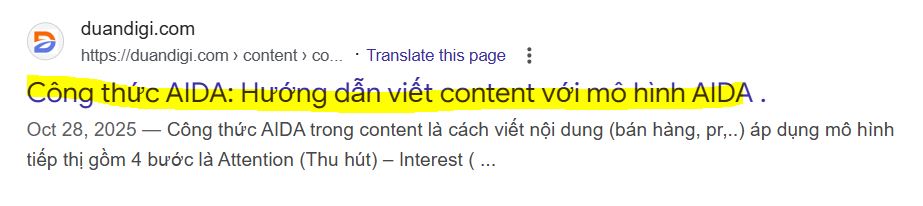
- Technical: Must be less than 60 characters, contain the main keyword (preferably at the top) and be unique throughout the website.
- Psychological (CTR Optimization): Must be engaging, intriguing, and promise a specific value (e.g., “30 – step checklist,” “update 2025”) to motivate users to click on your results instead of your competitors’.
Card H1:
This is the main headline, the biggest. inside the article of yours.

- Technical: There should be only one H1 tag per post. It should also contain the main keyword and can be identical or a longer, more natural variation of the title tag.
Sapo/Introduction
This is the most important first 150 words of the entire article, its goal is to help keep the reader engaged for the first 5 seconds to convince them that they have found the right place.
In my experience, to have a standard SEO sapo, you need to do the following 3 things:
- Hook (Hook): State the pain, problem, or big question the reader is having. (For example, “You wrote great, but it did n’t make the top?”)
- Promise: Promise the specific solution this article will provide. (For example, “In this article, I will share a 30-step checklist…”).
- SEO: Contains the main keyword (“how to write seo standard content”) naturally right in the first paragraph for Google to quickly confirm the topic of the article.
Body – The problem solving place
This is the core part of the article where you will make the promises stated in the Sapo (head paragraph) section. Here are some notes for this section:
- Structure: Content must be broken down by heading 2 (H2), heading 3 (H3), heading 4 (H4), … These tags act as directions, helping readers scan the content to find the meaning they need, while also letting Google understand the logical structure and the argument easier.
- Content: Each H2 addresses a key idea of content, containing related sub-keywords or semantic keywords, this is where you show your expertise and experience.
- Reading Experience (UX): The content of the article needs to use flexible images, videos, infographics, bullet points, bold the idea. The goal is to increase vividness, easy to understand to optimize the ease of understanding, easy to read by measuring can increase the time users stay on page (time on page).
- Structure paragraph: Do not write a paragraph too long, my experience is that just 2 -3 lines for a paragraph is enough.
Conclusion (conclustion)
This is an important part of the essay that is often overlooked or overdone by many writers. Remember that the conclusion is not just a “goodbye,” it needs to include the following:
- Summarize the core values, the main answers of the whole article.
- Reaffirm the main solution or advice. This is your last chance to show authority (Authoritativeness) and reinforce the message.
- Can contain main keyword or LSI keyword again naturally.
Call to Action (CTA)
Never let the reader go into a “missing line” after reading that article, but let them know what to do next. For themselves, a good CTA must be directly related to the reader’s search intentions.
- For example: If the reader is looking for “how to write”, the CTA should be “Download the 30 step checklist here”.
- For example: If the reader is looking for “SEO services”, the CTA should be “Contact for advice”.
- Other popular CTAs: “Leave a comment”, “Read more related articles”, “Share articles”.
Example of an SEO Standard Post (Practical Analysis)
You do n’t need to look for an example of a standard SEO article to find one. Because it’s the article you’re reading is a practical example of how to implement the SEO standards of content writing that we just discussed.
Let’s dissect it:
Title (Title & H1):
The article had a clear title: “How to Write SEO-Standard Content: Checklist 30 Steps To The Top 2025 “
This headline contains the main keyword, and uses the numbers “30” and “2025” to create credibility, updating and promise a specific value (CTR Optimization).
Link (URL):
The path of this article will be optimized to https://duandigi.com/how-to-write-seo-standard-content-checklist-30-steps-to-the-top-2025/. This is a short, user-friendly URL that is easy to understand and contains the exact key keyword.
Opening (Sapo):
The opening goes straight to “pain” (Good writing but not top), give a clear solution (checklist 30 steps) and set up E-E-A-T (through Digi’s real-world experience).
Structure (Structure):
The entire article is organized by H2, H3 tags in a very logical order: starting from “Definition” (What), “Fault”, “Why” and then going into “How” with 20 questions and 30 checklist steps.
Helpful Content:
Instead of talking about a theory, the article provides two core values that can be applied immediately: 20 Helpful Content self-advice questions and a detailed 30-step Checklist.
E-E-A-T Element:
Experience and Expertise are integrated throughout the Digi Travel and Battle Experience sections, proving that the content is written by people with real experience.
Optimized Reading Experience (UX):
Used Articles bold To emphasize key ideas, use bullet points and checklists to make information more absorbable, readable, and scannable.
Core Thinking: Google prioritizes Helpful Content over SEO Techniques
Before going into the 30 step checklist SEO standard writing techniques, we need to agree on the most important thinking that is:
SEO has changed. Google has launched the Helpful Content algorithm.
This means that if you write content that only makes it to the top and does n’t really help your readers, it will be underestimated or disappear from search results.
The way to write SEO standard content 2025 of his compilation is essentially the way to write Helpful Content.
Here are 20 core questions posed by Google itself. From real-world experience, Duan always used this questionnaire to assess the quality of his articles before publishing. As a result, a lot of content has achieved good rankings after publishing, some content that lost index is also indexed back to rank top “delicious peach”.
20 Questions about useful content for self-assessment
Group 1: Professional and Experience Questions (E-E-A-T)
- Does this content clearly show your actual experience and experience? (For example, do you actually use the product you are evaluating?)
- Is this content written by an expert or someone with a deep understanding of the topic?
- Is this information reliable? (For example, is it citing a reputable source or provides clear evidence?)
- Are you feeling confident and ready to put your (Author Bio) name under this article?
Group 2: Questions about Value and Content Depth
- Does this content provide original information, reports, research, or analysis?
- Does the content provide a complete, comprehensive, and complete description of the topic?
- Does the content provide an in-depth analysis or interesting information beyond the obvious?
- If this content is based on other sources, do you have add value and originality Is it significant, or is it just superficial rewriting or copying?
- Title and content that promises a value that the article Really… (Avoid titles like ” view, ” ” promise ” and ” no. “
- Is this the kind of page that a user would like to bookmark, share with friends, or recommend to others?
Group 3: Questions about the Reading Experience (Page Experience)
- Is the content well presented? (For example, is it cluttered, difficult to read, many formatting errors?)
- Is the content with spelling errors, serious stylistic errors?
- Is the content optimized to display well on mobile devices?
- Does the content contain too many distracting ads, which disrupt the user’s reading experience?
Group 4: Questions about Purpose (Write for Person or for Machine)
- Is this content written with the main purpose of attracting users from search engines (written for Google)?
- Are you producing a bunch of content on a variety of topics just in the hopes that they will work well on Google?
- Are you using AI (or handwriting) to summarize what others have said without adding any new value?
- Are you writing about a trending topic just because it’s hot, even if it doesn’t relate to your core readership?
- Does the content make the reader feel they need to re-search for better information from other sources? (Is your article a “endpoint” for this query?)
- Are you writing to a certain number of words (e.g., 2000 words) just because you heard that Google likes long articles?
Real-world view from Duan Digi:
If your article answers “No” to most of the questions in Groups 1, 2, and 3, and also answers “Yes” to most of the questions in Group 4, then that article will definitely fail. Even if you have an optimized 100 steps of technical SEO, Google will not appreciate it. Always prioritize “Useful Content for Users” to the top.
Checklist 30 Steps to Writing SEO Standard Content (A-Z Process)
This process is how you signal to Google that your content is useful, reliable and worthy of high rankings. I will divide it into 3 stages for you to easily refer to (because reading 1 time 30 checklists is confusing and difficult to remember)
Phase 1: Planning & Research (Before Writing)
This is the strategic stage, which determines 70% of the success of the article. Absolutely not ignored or skimmed.
- Define Post Goal Setting: What do you want your readers to do? sau khi Read finished? Learn knowledge? Sign up for emails? Make a purchase? This goal will determine the Call to Action (CTA) at the end of the post.
- Audience Persona Sketch: Who are they (newbies, experts)? What pain are they experiencing? What voice do they want to hear (serious, funny)? This determines Approach angle and… style of the article.
- Main Keyword Research: Choose a key keyword as the focus. This is the core phrase, with good search volume and best expresses the topic of the article (eg, “how to write seo standard content”).
- Search Intent Analysis: This is the most important step. You have to understand Why is it? users type this keyword. They want know (Informational – tutorials), do (Transactional), or Compare (Commercial – review)? Intent to search will determine Formatting your content.
- Secondary Keywords Research: These are longer keywords, questions (What, Why, How) revolve around the main keyword (eg “checklist writing seo standards”). They will become subheadings (H2, H3) in your outline.
- Semantic Keyword Studies (LSI): These are words or phrases Related to the topic, helping Google understand the context (e.g., “onpage optimization”, “helpful content”, “e-e-a-t”). Using LSI helps you avoid keyword cramming errors.
- Top 10 Competitors Analysis (SERP Analysis): Find the top 10 articles on Google. Analyze them: What headings do they have? How do they format? What is the average length?
- Find “Content Gap”: This is your chance to win. After analyzing your opponent, ask yourself, “What can I do better than them?” (e.g., they only have 10 steps, I give 30 more detailed steps; they lack E-E-A-T, I add real-world experience).
Stage 2: Framing & drafting (While writing)
This is where your research comes into play.
- Create Outline logic: Structure H1, H2, H3 based on sub keywords and analyze opponents. A good outline is like the design of the house.
- Write Title (Title Tag): Below 60 characters, containing the main keyword (first priority). This is the blue inscription on Google, which determines the click rate (CTR).
- Writing Card Meta Description: Below 160 characters, contain key keywords, summarize the content, and add an engaging call to action (CTA).
- Write URL (Path): Be brief, understandable, contain key words, unsigned, and use hyphens (e.g.:
.../cach-viet-content-chuan-seo). - Write the Opening Paragraph (Sapo): Attractive, contains natural key words in the top 100-150 words. Must “Hook” (inquisitive), state the problem and promise the solution.
- Content Deployment (Focus on Helpful Content): Start drafting. At this point, let’s forget about SEO and focus 100% on answering 20 Helpful Content questions, sharing the experience (E-E-A-T) in the most authentic way.
- Key Keyword Allocation: Make sure the main keywords appear naturally (1 – 1.5% density) in Opening, Conclusion, and 1 – 2 H2 cards. Absolutely no cramming.
- Integrated & LSI Sub-Keywords: Spread the sub keywords and semantics into the headings H2, H3 and in the content logically.
- Clear Heading Structure: Use ONE H1 card only. Use H2, H3, H4 … in the correct order of integration (like book index). Google uses heading to understand the article structure.
- Write short paragraphs: Keep paragraphs under four to five lines to help rest your eyes and make it easier to read on mobile devices.
- Use Bullet Points & Numbered Lists: (Like this checklist) to break down information, making it easier for readers to “digest” the content.
- Bold has a strategy: Use bold for key ideas, key keywords to emphasize, to help readers “scan” the content faster. Do not overuse.
Phase 3: Optimization & Editing (After Writing)
This is the “polishing” phase of writing your paper before it’s ready for publication.
- Optimized Image: Name the image file containing the keyword (e.g.
cach-viet-content-chuan-seo.jpg). - Write Alt Text: Write Alt Text describing the image (and containing keywords if logical) for all images. This helps Google to “read” the images and support the visually impaired.
- Image Compression: Reduce image size (less than 100KB) with tools (such as TinyPNG) to increase page load speed (Page Speed).
- Add Internal Link: Link to other relevant articles on your own website to keep readers engaged and navigate Googlebot.
- Add External Link: Link to 1 – 2 trusted sources (e.g., Google, HubSpot, research sites) to increase the credibility of your post.
- Add a Call to Action (CTA): Set a clear CTA at the end of the post (or mid-sentence if appropriate), in line with the goals set in Step 1.
- Spell & Grammar Check: Read it carefully or use the tool. Misspelling seriously reduces E-E-A-T.
- Proofreading: Read the article out loud. If you stumble, it means the sentence is not smooth, the reader will stumble as well.
- Add Table of Contents: Especially with long articles. Table of contents helps users to navigate easily and can create sitelinks on Google.
- Add Structured Data: Add Schema (e.g. FAQ Schema for frequently asked questions, HowTo Schema for tutorials) to help your post stand out on the search results page.
Guide to writing SEO standards in detail (Including images for newbies)
If the above 30-step checklist sounds a bit technically confusing, this section is for you. From experience, these are the 6 most core and intuitive steps for a beginner to be able to write SEO-standard articles right away.
Step 1: Find keywords and search intentions (Know what users want)
This is the first and most important step, because if you write without keywords, it’s like building a house without knowing who to build it for, without a blueprint.
Make sure you have done your research on the keyword you’re looking for first.
Or see the detailed instructions Keyword research steps Here.

Tools you can use when researching keywords that you use a lot:
- Google keyword planner (free)
- Keywordtool.io (free)
- SEMrush (Chargeable)
What is a keyword?
It is the exact phrase that users type in the Google search box. For example: “how to write seo standard content”, “how to make flan”, “sunscreen for oily skin”.

What is Search Intent?
That’s the… Reasons for why users type that keyword. They want know (instruction), want mua (sales), or want Compare (review)?
How to know intentions? (How to do practical):
The easiest way to do this is to Google the keyword and look at the first five results.
- If all 5 are “Instructions…”, “How to…”, “Steps…” (like this one), then Google understands that users want to learn how to do it.
- If all 5 posts are product pages of Shopee, Lazada … then Google understands that users want to buy.
Use AI tools that support:
You can use ChatGPT, Gemini, … or any tool to catch it researching intent to search, then you refer to supplement your writing plan.
The promt example that I use is as follows:
PROMPT

Bạn là một chuyên gia SEO cấp cao (10+ năm kinh nghiệm, am hiểu entity – semantic SEO – intent mapping – E-E-A-T – Helpful Content 2025 của Google).

Tôi sẽ cung cấp cho bạn một chủ đề hoặc cụm từ khóa chính.

Nhiệm vụ của bạn:

- Phân tích ý định tìm kiếm (search intent) của người dùng:

- Phân loại rõ: Informational, Navigational, Transactional, Commercial investigation.

- Giải thích vì sao bạn xác định ý định đó.

Xác định từ khóa cốt lõi cho bài viết duy nhất này:

- Từ khóa chính (focus keyword)

- Nhóm từ khóa phụ liên quan chặt chẽ (semantic & LSI keyword)

- Các câu hỏi phổ biến (People Also Ask / FAQ keywords)

- Từ khóa dài (long-tail keyword) có khả năng chuyển đổi cao.

Phân tích đối thủ top 5 Google hiện tại (SERP overview):

- Tên tiêu đề + URL + ý chính họ đang khai thác.

- Khoảng trống nội dung (content gap) mà họ chưa làm tốt.

Đề xuất cấu trúc bài viết tối ưu (SEO Outline):

- Tiêu đề chính (Title) có chứa từ khóa chính.

- Mô tả meta (Meta Description) hấp dẫn, ngắn gọn, có CTA.

- Mục lục (H2, H3) logic, tự nhiên, giúp người đọc dễ theo dõi.

- Gợi ý chèn schema phù hợp (FAQ, HowTo, Article…).

- Gợi ý nội dung Helpful (E-E-A-T):

- Gợi ý yếu tố “Experience” nên thêm vào bài (ví dụ: trải nghiệm thực tế, case study, review thật, nguồn uy tín).

- Cách trình bày giúp bài viết được đánh giá “chuyên gia – hữu ích – đáng tin”.

Tạo bảng tổng hợp cuối cùng gồm:

- Cột 1: Nhóm từ khóa

- Cột 2: Từ khóa cụ thể

- Cột 3: Ý định tìm kiếm

- Cột 4: Gợi ý chèn trong phần nào của bài viết (H1/H2/H3/FAQ).

⚙️ Yêu cầu trình bày kết quả rõ ràng, chia phần, dễ copy, có thể dùng ngay để viết bài chuẩn SEO.

Cụm từ khóa cần nghiên cứu: 👉 [fill in the main topic or keyword here]
(Ví dụ: “Services chăm sóc người già tại nhà”, hoặc “Bé 1 tháng tuổi bú bao nhiêu là đủ”)
Deadly mistake: If a user wants a “tutorial” post and you write a “sales” post, Google will never rank your post.
Step 2: Italian Assembly (H1, H2, H3)
Next, never start writing right away. Instead, build a good outline. Imagine that your outline is the “bone” or “footnote” of your paper, and it helps you write logically, without rambling, and makes it easy for your reader to follow.
Imagine your article as a book:
- H1 Card (Only 1) This will be the title of the book (the title of the article, for example, “How to Write SEO Content”).
- H2 Card is the name of the chapter (Main ideas of the article. For example: “H2: What is SEO standard writing?”, “H2: Article structure …”).
- H3 Card is sub-items in the chapter (Sub-notes clarify for H2. For example: “H3: Title and H1 Distinction”).
Why would you do that?
It helps the reader Scanning (scan) the article to find the ideas they need and it’s important to help Google understand the structure, know what the main ideas are, what the sub-ideas are.

Step 3: Write Title & Sapo
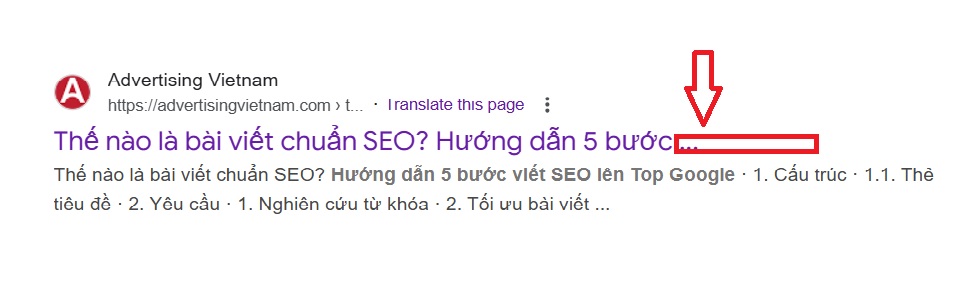
Title (Title Tag):
This is the blue, bold text that you see on the Google results page. It’s Others with the H1 tag (H1 is the title you see Inside articles).
- Mission: It should be less than 60 characters long, contain a main keyword, and be engaging enough to make your post click on rather than your competitor’s.
- Opening (Sapo): This is the first 100-150 words of the article. You only have 5 seconds to retain the reader. A good introduction must do 3 things:
- Empathy (Pain): “Are you writing well but no one reads?”
- Promise (Solution): “This article will give you a 30-step checklist…”
- SEO: Insert key words (“how to write seo standard content”) naturally.
Step 4: Write Body is easy to read
This is where you show off your expertise but remember that nowadays no one reads every word like before, they just scan the article. So your task is to make the article as easy to scan as possible.
- Do not write too long paragraphs: This is the most common error and there is still a long writing style. It is best never to write a paragraph that is 10 lines long.
- Write short sentences: Write simple, meaningful, easy to understand, proactive sentences.
- Split paragraph: Each paragraph should be 3-4 lines long, then down the line. A paragraph of about 2-3 lines is best, no matter how many sentences.
- Use bullet points (Bullet Points): When listing (as I am doing right now), use bullet points because they are extremely easy to skim.
- Use bold: Use bold for the main points you want your reader to see.


Step 5: Optimize Images (Tell Google what the image is about)
A standard SEO article is required to have illustrations with the purpose of enlivening and helping users understand the content better. But Google is a robot that is “blind”, so it can not see the exact content of your photos.
You have to tell it what your image is talking about:
File name: Before uploading your photos, rename your file.
- Bad Name:
IMG_1234.jpg - Good Name:
cach-viet-content-seo.jpg(without accents, using hyphens, containing the main keyword or related keyword, semantic keyword as possible).
For example: If I want to write an article with the main keyword is “how to optimize SEO”, the name of the image file can be: “cach-toi-uu-seo.jpg”, “kinh-nghiem-toi-uu-seo.jpg” or… “viet-title-chuan-seo” (because the title optimization is always in the literature on SEO optimization).
Alt Text (Alternative Text):
This is a must. When uploading a photo to a website (like WordPress, Haravan, etc.), you will see a box called “Alt Text” or “Alternative Text”.
Mission: Describe the photo briefly (eg, “SEO H1 H2 H3 standard post structure”).

💡 Two pieces of the puzzle that are often overlooked when writing SEO standards: duplicate content check (unique) and… organize your posts by topic cluster.
Step 6: Add Links & CTAs
Internal Link:
These are links that point to other articles on your own website. When you are writing, if you mention a related topic (e.g. “content pillar”), insert a link to the article about “What is Content Pillar” yours.
The goal of the internal link is to keep readers staying on the website longer and help Google understand your website has more relevant, in-depth information.
Conclusion & Call to Action (CTA):
Never end an article abruptly, but summarize 1 – 2 main points of the article with a motivational CTA or tell the reader what to do next. (Example: “Leave a comment below!”, “Read more X article”, “Contact us now!”).
Bottom line: SEO is technical and Content is heart
Writing SEO standard content is not as scary or complicated as you think, this article is really quite long but if you have finished reading and still do not understand, you just need to always remember the following two core things:
- Helpful Content must go first, SEO techniques follow. Always ask yourself a set of 20 “golden” questions about experience and value before you begin optimizing any technique.
- This 30-step checklist is a reference tool for knowing. Use it in a flexible and natural way, not as a mechanical cram of keywords or an indiscriminate overuse of bold.
Finally, his philosophy is that a successful article is one that the reader is grateful for having found, they love your content, Google will do the same.
💡 30 steps is pretty much everything — if you want to cut to the chase, SEO standard writing service of Duan Package from research to on-page optimization.