
You’ve probably heard of it a lot. AIDA model In sales or marketing. And really, AIDA formula in content is not just a theoretical, but it is a practical solution that is quite effective if you are facing problems such as: writing a lot of content, burning money on ads (advertising) a lot but no one watches, no one clicks, weak conversion.
With more than 10 years of experience in digital marketing, Duan realized that almost 90% of sales content fails for one reason: “writing without understanding customer psychology, not taking advantage of the effective structure available”.
In general, AIDA content writing formula is a guideline for psychology when writing advertising and sales content is quite effective in the present time. In this article, I will explain the recipe as well as introduce some effective templates, which I and my team have used to increase conversion rates for my marketing campaigns.
💡 Before diving into each letter A-I-D-A, you should firmly grasp the overall picture: What is content and popular content branches — it is easy to choose any formula once you understand the root.
What is AIDA Formula?
AIDA formula in content is a way of writing content (sales, pr, ..) applying a marketing model consisting of 4 steps: Attention – Interest – Desire – Action. The goal is to help content lead customers’ emotions and behaviors naturally, from paying attention to the product, feeling excited, generating desires until they can decide to take action (which can be purchases, registrations, contacts, etc.).
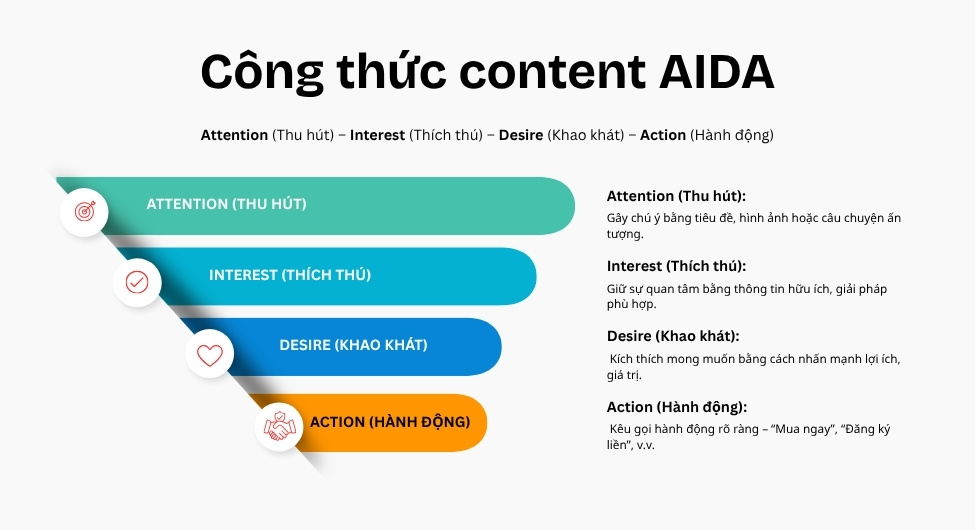
Explain AIDA content formula in content marketing:
You can understand the 4 steps in this content writing formula as follows:
- Attention (attraction): Start by drawing attention to yourself with a catchy title, a striking image, an interesting story, or a surprising message that will make your customers stop and want to learn more.
- Interest (interest): Once the attention is there, the next thing is to retain them with real value, by sharing useful information, helping customers better understand the problem they are facing. Then show that your product / service is the answer that best suits their case (potential customers).
- Desire (desire): This is the stage that awakens desire from customers, is the time to emphasize the specific benefits they will receive, so that they imagine life easier, better when using your products and services provided.
- Action (action): This is the last but most important step in getting your customers to take action. Use a clear and engaging call to action such as “buy today,” “sign up for a discount,” or “contact us for a free consultation” to help you close the deal more effectively.
Why is the AIDA model important in content?
Some of you may be confused that the AIDA model is a formula used for content writter. But for me, it’s different, as a regular full stack, I consider the AIDA formula in content as the “backbone” of the entire marketing funnel.
It’s not just a simple formula, it’s a miniature funel, modeled exactly on the four psychological stages of the client.
A previous experience when running Google Ads, I noticed that a lot of accounts burn money in a nonsense way. When they only have a very good ad title that attracts thousands of clicks, but when users click on the langding page, they see “bad” content, not very true to the promise of advertising in the title.
And of course, the bounce rate then goes up to 90% and finally click advertising but nothing or very little is gained.
That’s why the AIDA formula is popular content marketing This is called the “Divine Content Formula” in marketing and sales campaigns.
Benefits that AIDA brings:
- Attract and retain readers: The AIDA model forces you to be consistent with the overall content, including what the title promises, and the content must respond immediately. The goal is to retain potential customers on the website or langding page, reduce page bounce rates, and increase the effectiveness of ad spend.
- Optimal psychological flow: A good landing page is not a page that has to be too beautiful but it needs convincing. AIDA will structure the content in a natural psychological flow, smoothly leading the reader from “what is this” to “this seems good”, to help customers access information naturally without feeling compelled to sell.
- Increase Conversion: This is the ultimate goal, the most important, because not instead of “fighting” a bunch of features in the face of the customer, AIDA will help you build a story, hit the right psychology, evoke desire before calling for action. This can turn readers from viewers into buyers, from potential customers into real customers, helping to close more effectively on the approach channels such as website, landing page to email or an advertisement somewhere.
How is the content writing formula based on the AIDA model implemented?
This is the core part, my practical experience when applying AIDA formula for many different campaigns, including thinking and how to apply step by step.
In each step, I will present with 3 main factors including common mistakes that often cause content failure, how I optimize content with AIDA and AIDA templates for reference.
Step 1: Attention – Catch the customer’s attention in 3 seconds
This is the first but quite important gateway, because users only have 1 – 3 seconds to stop and see what’s interesting, whether Tiktok platform, Facebook, Google or Youtube are all so. If you fail at this step, 90% of your ads budget has been wasted.
Cause: The classic mistake is often seen as the over-the-top headline, which makes customers click but will get out immediately when the content is not relevant. For example, “Rich after a night thanks…” but when clicking again to sell cosmetics.
This will increase your bounce rate, causing Google and Facebook algorithms to rate your posts as spam and unnecessarily expensive ads.
How to do it right:
The title should be closely related to the content and should hit a customer’s “gospel.”
- Point it at the pain, the problem they’re struggling with.
- Use numbers and specifics instead of literal information, as the human brain tends to believe in specifics. For example, “Lose 10 pounds in 7 days” instead of just “lose weight fast.”
- Stimulate curiosity but be relevant, it can be a question, a statement that makes them wonder “why”.
Some sample sentences:
- Painfulness): “Are you writing a lot of content without writing a form?”
- (Pain): “It costs 5 million / month for acne cream and still does not work?”
- (Number): “10+ AIDA content writing templates helped me increase conversion rate by 50%.”
- (Number): “90% of Facebook ads runners make this mistake (and how to fix it).”
- (Curious): “Is the AIDA formula really as’ divine ‘as the rumors say?”
- (Curious): “What I used was not a cream, but it smoothed wrinkles after 3 nights.”
Step 2: Interest – Keep Your Readers Interested
At this point, let’s move on to the harder task of keeping customers (readers) on board, but do n’t rush to sell.
A lot of you make the mistake of this step, which is stuffing too many features right away, talking about what your product is, etc. This is bad, so instead say what the product/service does for them.
The right way to do this is to empathize and show your clients that this article is relevant to them.
- Turning features into benefits is a core skill of copywriting, with the formula [features]…. help…. [benefits”
- Tell stories using storytelling, a short story about yourself or someone else who has had the same problem.
- Use statistics or interesting facts to provide immediate value to build credibility for your content.
Reference sentence form:
- (Features -> Benefits): “This course has 100 videos (features) so you can study anytime, even when you are at work (benefit).”
- (Stories): “I was like you, I spent 30 million ads a month and only got a few applications. Until I realized…”
- (Statistics/Value): “Did you know? According to HubSpot, 90% of customers believe in a feedback rather than an ad. And you…”
- (Suspension from A to I): “The truth is, it’s not the product, it’s the way you’re talking about it…”
Step 3: Desire – Make customers desire, enjoy and aspire
This is the step I find the most difficult and almost 80% marketers weak. Because if you only make customers like but not sufficiently aspire, it is just “window shopping” (i.e. viewing through the glass) so they will not buy.
Customer Lead Phase “Aspiration” this is a product that needs to be effective, and you need to push the emotion even further, to make the prospect feel like they have to have this product.
But most marketers just stop at listing the benefits, like “This cream helps skin look more beautiful“. This is quite good but not “cool enough”, not creating a feeling of” I want it now “in the customer.
The right way to do it is to use a combination of three psychological weapons to get customers to switch from “liking” to “craving.”
- Social Proof: People trust others more than they trust you, so show them that others have succeeded.
- Fear of Missing Out (FOMO): People are more likely to fear loss than to want more.
- Plot the scenario: Sell them a better version of themselves.
Some sample sentences:
- (Social Proof): “Don’t believe me. Look what Lan (the mother of two children) said after using this template: [Insert screenshot feedback].”
- (Social Proof): “More than 5,300+ shop owners have downloaded and applied successfully.”
- (FOMO): “This 50% off will be over in 24 hours.”
- (FOMO): “I only get 1-1 consultations for the 5 earliest subscribers this month.”
- (Spotlight Drawing): “Imagine, in just a month, you’ll be writing a 100 – order ad with confidence, no matter who you depend on.”
- (Spotlight Drawing): “How would you feel waking up with a shiny, acne – free skin?”
Step 4: Action – Call for clear action
When you’ve done everything perfectly and the customer is hungry for what they want, but if you do n’t “order” them to do what’s next, they wo n’t do anything.
I made this mistake once, which means that there are still call to action (CTA) buttons but only on a generic level, calling weakly like “contact now”, “find out more”, “click here”. This type of call to action fails because they are quite vague, leaving customers with no idea what happened and no value (they get nothing when clicking).
The right way to do it is to have a more effective, specific, powerful CTA that reduces the risk to the client almost completely. I improved later with more specific buttons that clearly state what they will get, for example, “download checklist PDF” instead of “download” as before. In addition, it is necessary to identify the “risk” issues in the minds of customers and find ways to remove all barriers that make them hesitate, so that conversion rates are effective.
Reference sentence form:
- (Weak): “Registered”
- (Strong): “Register for a 7-day free trial (No credit card required)”
- (Weak): “Download”
- (Strong): “Download 10+ Free AIDA Templates (.PDF)”
- (Weak): “Mua ngay”
- (Strong): “Buy now (Commitment to refund 100% if not satisfied)”
- (Weak): “Contact Consultant”
- (Strong): “Get a free 1-1 consultation (Only 3 slots available)”
10+ Template examples of AIDA formulas are used throughout
The basic theory is that, to make it easier to visualize, you can refer to the content marketing template with AIDA that I used to apply, if you want to use it, you need to edit a little to suit your product.
Template AIDA used to write sales ads on Facebook/Social Ads
- [A – Attention]: The first three lines determine everything. You have to hit the headlines, hit the pain.
For example: “You are ‘burning money’ for facebook ads without making a request? 90% of shop owners are wrong in this step…”
- [I – Interest]: Empathize immediately. Show them you understand their problem.
For example: “I understand, you tried everything: change content, change target … but the single latch rate is still stuck. The problem is not in the product, but in the HOW YOU Write …”
- [D – Desire]: Present the solution (your product) + Proof (K-HFeedback) + Benefits they get.
Example: “The solution is this Set of 20 AIDA advertising templates. It’s not just a sentence template, it’s a ‘psychological formula’ that helps… [Insert feedback photo: ‘Watching Sister Lan has increased sales by 30%…’]”
- [A – Action]: Call to action + Offer (FOMO) + Clear Link.
Example: ” Download 20 Template Set (FREE) – Only for the first 100 subscribers! Link here: [link]”
Template AIDA for writing email marketing
With email, you have more space to tell stories and build trust with your customers.
- [A – Email Header]: It’s got to be curious, personalized.
For example: “[Name], are you making these 3 fatal content mistakes?”
- [I – Interest]: Tell a valuable story/case study. Don’t sell yet.
For example: “Last week, a client of mine (a fashion store owner) increased email click rates by 50% by changing only one thing in the header…”
- [D – Desire]: Show how your services help them achieve results like case studies.
For example: “The secret lies in how he applied [Name Feature X] in our Email toolkit. It helped personalize the header based on behavior…”
- [A – Action]: Call for specific action, relevant to what you just read.
For example: “Would you like to try this X feature? Sign in and try it out now (7 days free).”
AIDA Formula for Short Video Script Writing (TikTok/Reels – 15 seconds)
The short video is the fight of the first 3 seconds. AIDA is maximally compressed.
- [A – first 3 seconds]: Hooks shock or point directly to the problem.
Scenario: (Hold a bill of ads) “DON’T RUN ADS… if you don’t know this!”
- [I – 5 seconds later]: Quickly explain the problem.
Scenario: “Your content is unstructured, causing customers to ‘fall’ away in the first 5 seconds.”
- [D – 5 seconds later]: Present solution (product) extremely fast.
Scenario: “Use the AIDA formula. Here, see me write a single – page ad in 30 seconds [Screen Rewind]…”
- [A – last 2 seconds]: Call (Follow/Click link bio).
Scenario: “Follow me to learn more tips about content, or click the bio link to receive a free AIDA template!”
Apply AIDA formula when writing product description (Landing Page/Shopee)
On the sales page, most customers already have demand, so your task will be easier than turning Interest into Desire and Action.
- [A – Name of the enterprise]: Product Name + Strongest Benefit.
Example: “Bluetooth X50 Headphones [Active Noise Cancelling – 8 hours of no ear pain]”
- [I – Benefits]: Highlight benefits (not features).
Example: (Use icon) 🎧 Immersive sound: Feel every bass beat like at a concert. / 30 hour buffalo battery: Use all week without charging. / ☁️ Light as no: Only 20g, wear it to work all day…”
- [D – Desire]: Images/Videos used + Customer reviews.
Example: [Insert photo of a person wearing headphones doing a focused work] + [Screenshot 5 5 star rating: “Great, office noise disappears completely!”]
- [A – Action]: Clear CTA button + Commitment (Reduces risk).
Example: [BUY NOW – FREE SHIPPING Button] / “Commitment 1 for 1 in 12 months if error.”
Quick checklist to evaluate if the article has applied the AIDA formula effectively
An important note that I want to emphasize is to “check back” before running ads or posting. You can refer to the checklist below based on my experience:
Accordingly, answer with or without the following questions:
- Attention: Does the title make people stop for 3 seconds?
- Attention: Does the title PROMISE a benefit or SETTLE a specific pain?
- Interest: Does the first 3 lines make them want to read on (or are you selling right away)?
- Interest: Are you talking about Benefits or just Features? (Customers buy “beautiful skin” rather than “20 percent Vitamin C”).
- Desire (desire): Do you use Feedback/Case study/Evaluation (Social Evidence) to increase your libido?
- Desire (desirable): Do you feel like FOMO (time, quantity scarcity)?
- Desire (desirable): Do you “vision” the results after they use the product?
- Action: Is your CTA SPECIFIC? (Example: “Sign up” is VERY MUCH compared to “Sign up for free checklists via email”).
- Action: Have you added COMMITMENT (Reduce risk) right near the CTA button? (Example: Refund, Free Trial, No Credit Card Needed…).
If you answered “no” to any of these questions, go back and correct them immediately!
Experience “Full stack”: When to use AIDA, when to use PAS?
As a freelancer “full stack marketing”, I feel that AIDA model is very strong in marketing but not the only and best. Because in some cases, I prefer to use PAS (Problem – Agitate – Solve) More than AIDA.
Here is a fairly straightforward comparison of the basics between AIDA and PAS to help you clearly see when to use them:
| Criteria | AIDA (Attention – Interest – Desire – Action) | PAS (Problem – Agitate – Solution) |
|---|---|---|
| Approaches | Lead your emotions step by step from awareness → excitement → desire → action. | Address the problem, dig deep, and then offer a solution. |
| Target use | – Building brand identity – Introduce new products – Market education – Customer nurturing (email, blog) | – Run ads for new customer groups (cold traffic) – Remarketing (remarketing) – Promote products that solve urgent problems |
| Key impacts | Induce positive emotions, create trust, and long – term desire. | Create strong emotions, elicit anxiety or frustration to prompt quick action. |
| When to take | When products or services need time for customers to understand, consider, or build trust. | When the product solves a “hot” problem, urgent, or when you want customers to act right away. |
| Example illustration | AIDA: Did you know that 80% of Vietnamese people lack sleep? (Attention) Lack of sleep can make you tired and less focused. (Interest) Just one cup of X herbal tea every night will help you sleep better. (Desire) Order today to feel the difference! (Action) | PAS: (P) The inflammation is swelling? (A) There’s an important appointment tomorrow morning and you’re looking… (S) Use immediately X-spots – collect acne in 4 hours! |
His experience:
- AIDA is more appropriate when you want to build a long – term relationship that nurtures the perceptions and feelings of your customers (consumers).
- PAS is quite effective when you need to activate action quickly, hitting the customer pain.
3 Fatal mistakes when applying AIDA I have ever made
Applying the formula without understanding the nature will very easily lead you to failure.Here are 3 mistakes that I have made and it seems that many people repeat that mistake as I do.
You should avoid them if you want to apply good content writing with the AIDA formula:
- Unrelated AIDA funnel fracture: This is a common error, as the title is very good, very attractive, very shocking but the content inside is unrelated, or not as true as the title said.
- Forget Desire makes content lack emotion: This is a common mistake in technical articles, SEO, the article becomes a document that provides dry parameters, leaving customers with no desire, “desire” after reading it.
- Hidden CTAs are hard to see, calls for weak action that is hard to close the sale: It may be a CTA button that is too small, a sinking color, or generic words that are not strong enough.
💡 AIDA is just one of many frameworks. If you want to compare, see more commonly used content writing formula set and how to provoke pain with PAS model to select the right frame for each goal.
Conclusion: AIDA is not a spell, it is a tool.
In general, to be good at AIDA content formula, you have to practice writing a lot with it, having to revise it many times. Because I used to be the same, also wrong with the number of times “n” i don’t remember.
Through this article, you can see that the AIDA formula in content is an extremely powerful psychological tool, but it is not a “common mantra” written out as a single document. It should be considered only as a “tool”, a framework to support you in writing content. Hope this information is useful to you! Wish you success with the AIDA formula when writing content.
💡 No time to practice writing by formula? You can to SEO standard writing recognition and hand over the content has optimized conversion.
